
A Bearing Manufacturer’s Guide to Understanding Price Differences and Comparing Quotations Correctly
Key Takeaways
As a bearing manufacturer, I regularly see buyers receive three, five, or even ten quotations for what appears to be the same bearing—and then struggle to understand why the prices can differ by 20%, 50%, or sometimes several times over.
The answer is that the same bearing model does not necessarily mean the same bearing quality, manufacturing process, commercial condition, or supply source.
A quotation may be affected by:
- Steel grade and raw-material source
- Heat-treatment quality
- Machining and grinding accuracy
- Rolling-element grade
- Cage, seals, and lubrication
- Precision and internal clearance
- Inspection standards
- Production scale and equipment capability
- Order quantity
- Brand and distribution channel
- Inventory age
- Delivery time
- Payment terms
- Warranty and technical support
- Whether the product is genuine, OEM, surplus, refurbished, or counterfeit
This is why I do not recommend choosing a bearing supplier by unit price alone.
The correct question is not:
“Which quotation is the cheapest?”
It is:
“Why is this quotation cheaper, and what exactly am I receiving for that price?”
Once a buyer can answer that question, bearing quotations become much easier to compare.
Executive Summary
Price comparison is a normal and necessary part of bearing procurement. The difficulty is that quotations often appear comparable when they actually describe different products.
Two suppliers may both quote “22220 C3,” but one may use premium bearing steel, controlled heat treatment, brass cages, strict raceway grinding, and full dimensional inspection, while another may use lower-cost steel, outsourced heat treatment, wider tolerances, and limited inspection.
Both bearings may have the same nominal dimensions.
Their price—and their operating performance—can be very different.
Price differences can also result from perfectly legitimate commercial reasons. A manufacturer producing the model in large quantities may have a lower cost than a small supplier. A distributor holding local stock may charge more because the buyer receives immediate delivery. An authorized international-brand distributor may include brand premium, traceability, warranty, and local service. A manufacturer selling directly may eliminate several layers of distribution margin.
Therefore, the purpose of this guide is not to tell buyers that expensive bearings are always better or that inexpensive bearings are always poor quality.
My objective is to help procurement professionals understand where the price difference comes from, which differences matter, which differences do not, and how to compare quotations on an equal basis before making a purchasing decision.
Introduction: Why the Same Bearing Can Have Completely Different Prices
A buyer sends the same RFQ to five suppliers.
The requirement is:
Spherical Roller Bearing
Model: 22220 C3
Quantity: 100 pcs
The quotations come back:
- Supplier A: USD 65/pc
- Supplier B: USD 92/pc
- Supplier C: USD 118/pc
- Supplier D: USD 175/pc
- Supplier E: USD 260/pc
Naturally, the procurement manager becomes confused.
Everyone says:
“Our quality is very good.”
Everyone says:
“We use good material.”
Everyone says:
“Our price is competitive.”
So who should the buyer believe?
This is where bearing purchasing becomes difficult.
The model number tells us the general type and dimensions, but it does not necessarily tell us the entire manufacturing story.
As a manufacturer, when I see a large price difference, I normally investigate four areas:
- Are the suppliers actually quoting the same technical specification?
- Are they producing the bearing to the same quality level?
- Are their manufacturing and commercial cost structures different?
- Are they selling through the same type of supply channel?
If the answer to any of these questions is “no,” then the quotations are not truly comparable.
1. The First Reason: The Bearings May Look the Same but Be Technically Different
This is the first thing I recommend checking.
Before comparing price, normalize the specification.
A basic model may hide important differences.
For example, a bearing may differ in:
- Precision grade
- Internal clearance
- Cage material
- Seal structure
- Lubrication
- Heat stabilization
- Rolling-element accuracy
- Radial runout
- Axial runout
- Noise and vibration requirement
- Special coating
- Surface treatment
- Material grade
Even if all suppliers write the same basic model number, their internal interpretation may be different.
Example: Brass Cage vs Steel Cage
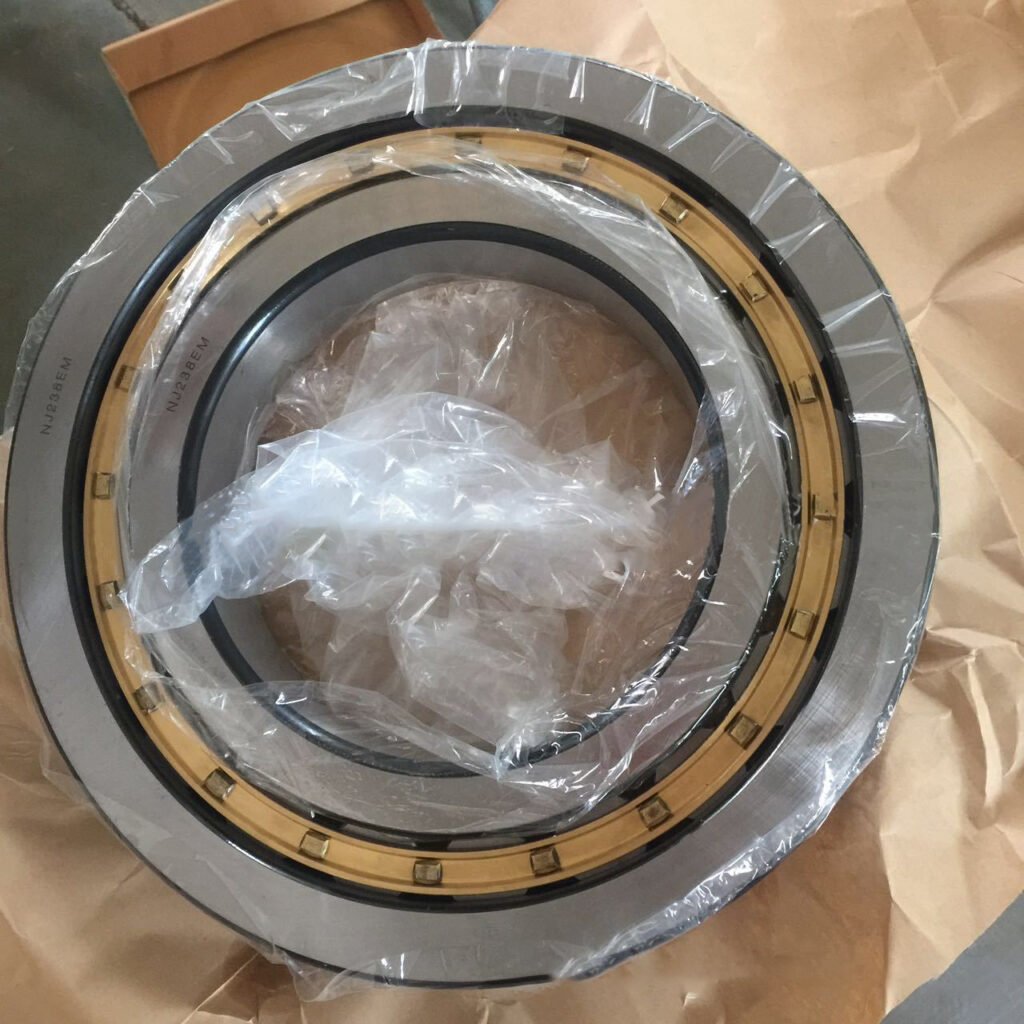
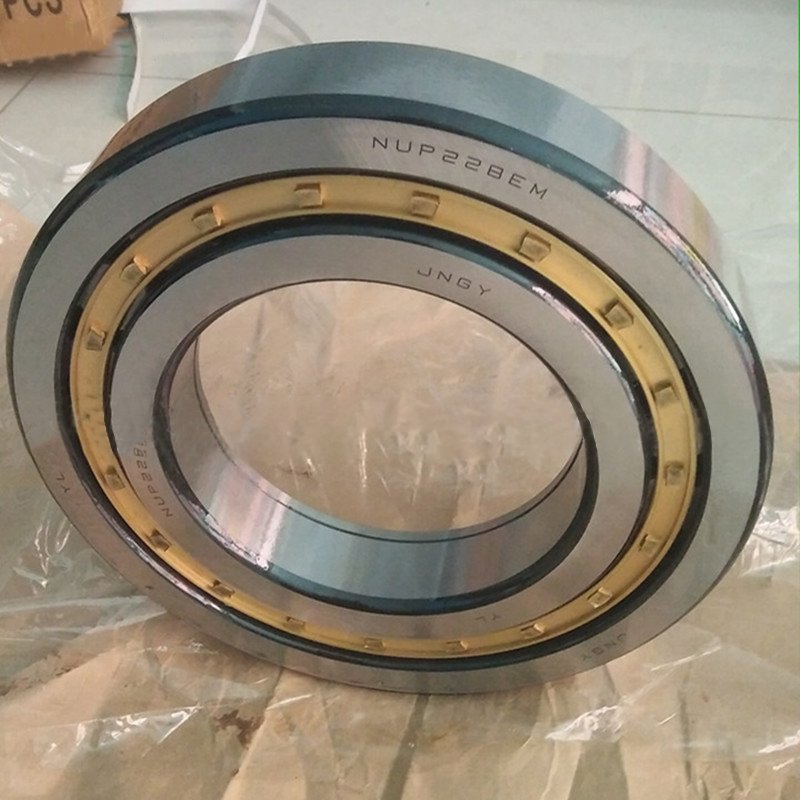
A machined brass cage is normally more expensive than a pressed steel cage.
If Supplier A quotes a brass-cage spherical roller bearing and Supplier B quotes a steel-cage version, their prices should not be compared directly.
Example: P5 vs Normal Precision
Producing a P5 bearing requires tighter dimensional and rotational tolerances.
This may involve:
- More accurate grinding
- More inspection
- Better process control
- Higher rejection rates
- More expensive measurement equipment
Therefore, the price is naturally higher.
Example: C3 Clearance vs Standard Clearance
Internal clearance itself may not create a dramatic price difference, but correct control requires accurate matching of rings and rolling elements.
A low-cost supplier may simply label the bearing “C3” without maintaining a consistent C3 range.
From a buyer’s perspective, the label may be the same while the actual product is not.
My Recommendation
Before comparing quotations, create one technical specification sheet and send exactly the same requirement to every supplier.
At minimum, confirm:
- Full model
- Dimensions
- Material
- Cage
- Clearance
- Precision
- Seals or shields
- Lubrication
- Quantity
- Required quality documents
- Application
Only then does the price comparison become meaningful.
2. Steel Quality Can Create a Significant Price Difference
Steel is one of the largest direct costs in bearing manufacturing.
However, saying “bearing steel” is not enough.
Different steel suppliers may have different levels of:
- Chemical consistency
- Cleanliness
- Non-metallic inclusions
- Carbide distribution
- Oxygen content
- Heat-treatment stability
- Fatigue resistance
Two manufacturers may both state that they use GCr15, 52100, or 100Cr6.
That does not automatically mean the steel quality is identical.
Why Cleanliness Matters
Bearings operate under repeated rolling-contact stress.
Microscopic inclusions inside the steel can become fatigue initiation points.
The cleaner and more consistent the steel, the better its potential fatigue performance.
High-quality bearing steel therefore normally costs more than general-purpose steel that merely meets a basic chemical composition.
Where Low-Cost Suppliers Can Save Money
A supplier can reduce raw-material cost by:
- Purchasing from a lower-tier steel mill
- Accepting wider material variation
- Buying uncontrolled stock
- Using recycled material with weak traceability
- Reducing incoming material inspection
These savings are largely invisible in the finished bearing.
The buyer sees a polished steel ring.
The difference may only become visible after thousands of operating hours.
What Buyers Should Ask
Instead of asking:
“Do you use bearing steel?”
ask:
“Which steel grade do you use, and from which steel mill?”
For important projects, request:
- Material certificate
- Heat or batch number
- Steel supplier information
- Chemical composition
- Relevant material standard
A reliable manufacturer should be able to explain its material source.
3. Heat Treatment Is One of the Biggest Hidden Price Differences
Heat treatment is another area that buyers cannot easily see.
Yet it strongly affects:
- Hardness
- Wear resistance
- Fatigue life
- Toughness
- Dimensional stability
Two bearings can look identical after grinding even if their heat-treatment quality is very different.
A Professional Heat-Treatment Process Requires Cost
The manufacturer must control:
- Furnace temperature
- Heating time
- Quenching
- Cooling
- Tempering
- Hardness
- Distortion
- Metallurgical structure
Large bearings may require additional processes such as:
- Raceway induction hardening
- Gear hardening
- Stress relieving
- Deep case hardening
All of these require equipment, energy, skilled operators, and inspection.
How Price Can Be Reduced
A low-cost producer may save money by:
- Shortening process time
- Using simpler equipment
- Reducing inspection frequency
- Outsourcing to the cheapest heat-treatment provider
- Accepting wider hardness variation
- Reducing hardening depth
These savings may not immediately affect dimensional inspection.
But they can affect service life.
Manufacturer’s Advice
When the price difference is large, ask the supplier:
- What hardness range do you control?
- Is heat treatment performed in-house or outsourced?
- Can you provide hardness records?
- For large bearings, what is the hardened layer depth?
- How is raceway hardness verified?
The quality of the answer often tells you a great deal about the factory.
4. Grinding Accuracy and Surface Finish Have a Direct Cost
After heat treatment, bearing rings require precision grinding.
This is where many of the most important dimensional and geometrical characteristics are created.
The manufacturer may need to control:
- Raceway geometry
- Roundness
- Cylindricity
- Raceway profile
- Surface roughness
- Radial runout
- Axial runout
- Width variation
Higher accuracy means:
- Better machines
- Better grinding wheels
- More frequent dressing
- Longer cycle time
- More measurement
- More skilled operators
- Higher rejection rates
All of these increase manufacturing cost.
Why This Matters
If a supplier widens tolerances slightly, production becomes easier and cheaper.
The bearing may still fit into the machine.
However, under operation, wider geometric variation can cause:
- Uneven load distribution
- Increased vibration
- Higher operating temperature
- Noise
- Reduced rotational accuracy
- Premature fatigue
This is particularly important in:
- Electric motors
- Gearboxes
- Machine tools
- Precision rotary tables
- High-speed equipment
- Industrial robots
When comparing quotations for these applications, precision cannot be treated as a minor detail.
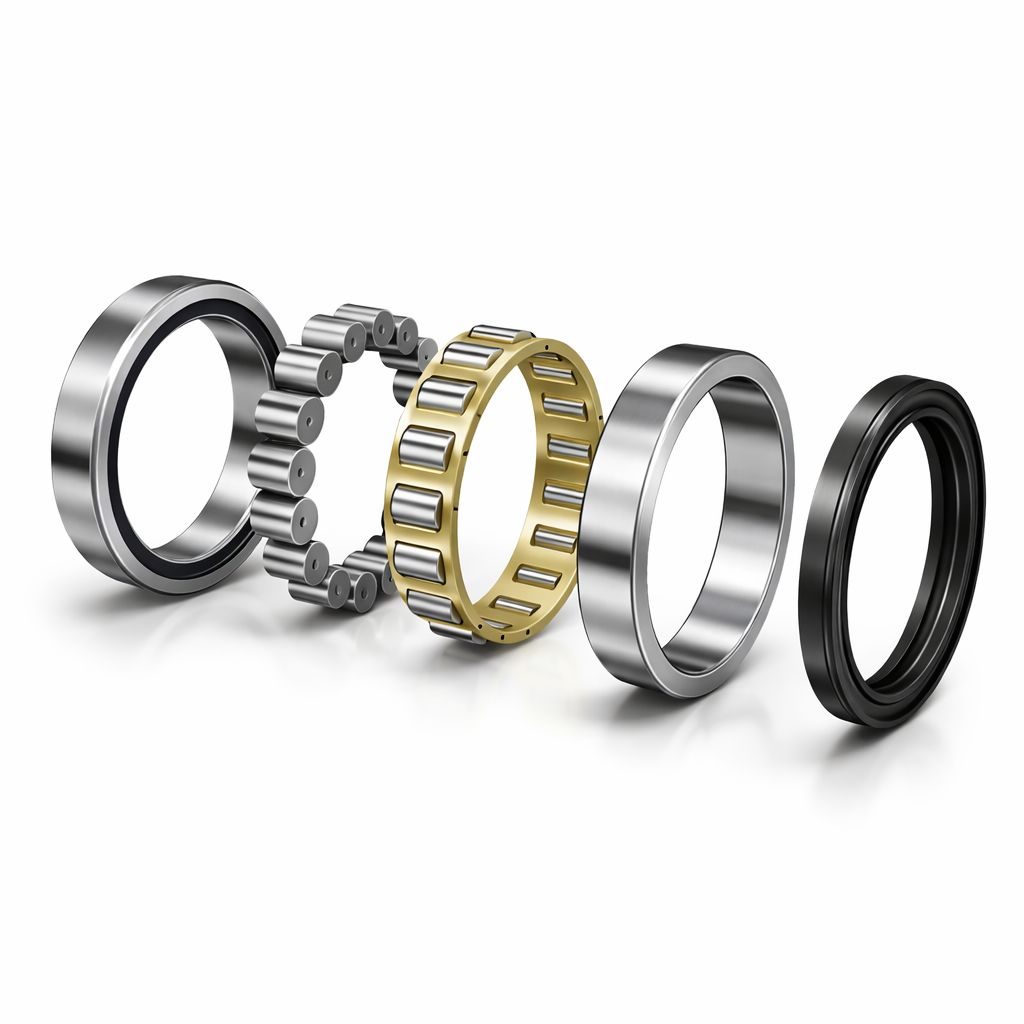
5. Rolling Elements, Cages, Seals, and Grease Also Affect Price
Many buyers focus almost entirely on the bearing rings.
But the complete bearing contains multiple components.
Balls and Rollers
Rolling elements differ in:
- Dimensional grade
- Roundness
- Surface finish
- Material quality
- Size consistency
Higher-grade balls and rollers cost more.
Cages
Different cages have different costs.
Examples include:
- Pressed steel
- Machined brass
- Polyamide
- PEEK
- Special alloys
A machined brass cage may require considerably more material and machining than a pressed steel cage.
Seals
Seal materials vary in:
- Temperature resistance
- Chemical resistance
- Friction
- Wear performance
Standard rubber and high-temperature fluorocarbon seals are not equivalent in price.
Grease
Lubrication can also change the quotation.
Standard industrial grease may be inexpensive.
Special lubricants from brands such as Klüber, Mobil, Shell, or other premium manufacturers can cost much more.
Applications may require:
- Food-grade grease
- High-temperature grease
- Low-temperature grease
- High-speed grease
- Water-resistant grease
- Vacuum grease
If Supplier A quotes standard grease and Supplier B quotes a specified premium grease, price comparison without checking lubrication is misleading.
6. Inspection Standards Can Explain Part of the Price Gap
Another hidden cost is inspection.
A manufacturer with a mature quality system invests in:
- Measuring machines
- Roundness testers
- Roughness testers
- Hardness testers
- Vibration instruments
- Noise testing
- Ultrasonic testing
- Magnetic-particle inspection
- Gear measurement
- Calibration
- Quality personnel
These investments eventually become part of the manufacturing cost.
Two Very Different Quality Systems
Factory A may inspect:
- Incoming steel
- After turning
- After heat treatment
- During grinding
- During assembly
- Before shipment
Factory B may inspect:
- Final dimensions only
Both suppliers can tell the buyer:
“We inspect every bearing.”
But those statements do not describe the same quality system.
The Buyer’s Question Should Be:
Not:
“Do you have inspection?”
But:
“Which characteristics do you inspect, at which stage, and with what equipment?”
That question gives much more useful information.
7. Production Scale and Equipment Capability Can Make a Good Bearing Cheaper
A lower quotation does not automatically mean lower quality.
Sometimes the lower price comes from better manufacturing economics.
A large manufacturer producing thousands of the same bearing series may have:
- Higher equipment utilization
- Better raw-material purchasing prices
- Automated production
- Lower setup cost per unit
- More efficient heat-treatment batches
- Established tooling
- Lower labor cost per bearing
- Better scrap utilization
Therefore, it may legitimately quote less than a small factory.
Outsourcing Can Increase Cost
A small manufacturer may outsource:
- Forging
- Heat treatment
- Grinding
- Cage production
- Roller production
- Inspection
Each additional supplier may add:
- Margin
- Transportation
- Handling
- Coordination
- Minimum batch charges
A more integrated factory may produce the same quality at a lower cost.
This is one reason buyers should compare factory capability, not assume that higher price always equals higher quality.
8. Order Quantity Has a Major Effect on Price
Bearing manufacturing includes fixed setup costs.
For example:
- Engineering review
- Machine setup
- Tool preparation
- First-piece inspection
- Production scheduling
- Heat-treatment batch setup
- Grinding adjustment
If these costs are distributed across 10 bearings, the unit price is high.
If distributed across 1,000 bearings, the unit price becomes much lower.
This is why:
10 pcs × USD 50
does not mean:
1,000 pcs × USD 50
A professional RFQ should always include both:
- Current order quantity
- Expected annual demand
That allows the manufacturer to calculate a more realistic production price.
9. The Purchasing Channel Can Create Huge Price Differences
Another common source of confusion is comparing quotations from completely different sales channels.
Consider the possible chain:
Manufacturer → Exporter → Regional Agent → Distributor → Local Dealer → Buyer
Each company adds:
- Margin
- Inventory cost
- Credit cost
- Staff
- Warehouse
- Warranty responsibility
- Technical support
The final price can therefore be significantly higher than the factory price.
But this does not mean the distributor is “overcharging.”
The buyer may receive:
- Immediate stock
- Local payment terms
- Small MOQ
- Next-day delivery
- Local warranty
- Technical support
- No import procedure
These services have value.
Direct Manufacturer Pricing
Buying directly from a manufacturer may reduce:
- Distributor margin
- Agent margin
- Local stocking margin
But direct sourcing may require:
- Larger quantities
- Longer lead time
- International freight
- Import customs
- Advance payment
- Inventory planning
The correct channel depends on the buyer’s purchasing pattern.
10. Brand Premium Is Real
A well-known international bearing brand does not charge only for steel and manufacturing.
Its price may also include:
- Decades of R&D
- Application engineering
- Global technical support
- Distribution network
- Brand reputation
- Warranty
- Product-development cost
- Extensive testing
- Inventory availability
- Certification
- Global customer service
This is why comparing a premium international brand directly with a qualified OEM manufacturer solely by unit price is not always fair.
The products may perform similarly in a specific application, but their commercial models are different.
Procurement Decision
Ask:
Does this application require this specific brand?
If yes, purchase through an appropriate authorized source.
If not, you may evaluate technically qualified alternative manufacturers.
For recurring, high-volume applications, this can create significant savings.
11. Inventory Age and Availability Can Affect the Price
Stock bearings may have very different commercial histories.
One supplier may be quoting:
- Fresh production
Another may offer:
- Five-year-old inventory
Another:
- Project surplus
Another:
- Distributor liquidation stock
Another:
- Returned inventory
This can create large price differences.
Old stock is not automatically bad if:
- Storage conditions were controlled
- Corrosion protection is intact
- Grease is still acceptable
- Packaging remains suitable
- Traceability is available
But buyers should know what they are purchasing.
Ask:
- Production date?
- Storage history?
- Is the packaging original?
- Is the product unused?
- Why is the price lower?
12. Extremely Low Prices Can Signal Counterfeit or Misrepresented Bearings
This is especially important when buying famous brands.
If the normal market price of a premium bearing is approximately USD 500 and an unknown supplier offers “the same original bearing” for USD 150, buyers should not immediately celebrate.
They should investigate.
Possible explanations include:
- Surplus inventory
- Parallel imports
- Old stock
- Damaged packaging
- Incorrect model
- Used or refurbished product
- Unauthorized source
- Counterfeit bearing
An unusually low price is not proof of fraud.
But it is a reason to demand stronger evidence.
A procurement manager should never allow an attractive price to replace supplier verification.
13. Payment Terms and Commercial Risk Affect Pricing
Supplier quotations also reflect financial conditions.
Compare:
100% payment before production
with:
Net 90 days after delivery
The manufacturer is providing financing in the second case.
That financing has a cost.
Other price factors may include:
- Currency
- Deposit percentage
- Credit period
- Exchange-rate risk
- Warranty period
- Cancellation terms
- Production reservation
- Customer-specific inventory
Therefore, compare quotations under the same commercial terms.
14. Delivery Time Can Also Change the Price
An urgent order may require:
- Overtime production
- Dedicated machine scheduling
- Smaller heat-treatment batches
- Expedited raw materials
- Express inspection
- Air freight
All of these can increase cost.
Conversely, a buyer providing a realistic forecast gives the manufacturer time to:
- Combine production batches
- Purchase steel efficiently
- Schedule equipment
- Use normal freight
- Reduce emergency cost
Good planning can therefore reduce bearing cost without changing quality.
15. How Should Procurement Managers Compare Bearing Quotations?
This is the most important part of the article.
When quotations vary significantly, I recommend using a structured comparison instead of looking only at the price column.
A useful comparison table looks like this:
| Comparison Item | Supplier A | Supplier B | Supplier C |
|---|---|---|---|
| Complete Model | ✓ | ✓ | ✓ |
| Material Grade | GCr15 | GCr15 | Not specified |
| Steel Source | Identified | Identified | Unknown |
| Precision | P5 | P5 | Normal |
| Clearance | C3 | C3 | C3 |
| Cage | Brass | Brass | Steel |
| Grease | Klüber | Equivalent | Standard |
| Heat Treatment | In-house | Outsourced | Unknown |
| Inspection | Full report | Final only | Not specified |
| Quantity | 500 | 500 | 500 |
| Lead Time | 45 days | 35 days | 20 days |
| Warranty | 12 months | 12 months | Not stated |
| Technical Support | Yes | Yes | Limited |
| Unit Price | $118 | $102 | $68 |
Now the price difference begins to make sense.
Supplier C may still be a valid option—but it is clearly not quoting the same technical scope.
Compare Specifications First, Price Second
My recommended sequence is:
- Confirm complete model.
- Confirm technical specification.
- Confirm material.
- Confirm precision and clearance.
- Confirm cage and lubrication.
- Confirm inspection.
- Confirm manufacturer capability.
- Confirm quantity and delivery.
- Confirm commercial terms.
- Compare price.
Price should be the last major comparison, not the first.
16. Questions to Ask When One Quotation Is Much Lower
If a quotation is substantially lower than the others, do not reject it immediately.
Ask the supplier to explain.
Useful questions include:
Technical Questions
- What steel grade do you use?
- Which steel mill supplies the material?
- What precision grade are you quoting?
- What clearance?
- What cage?
- What grease?
- What hardness?
- What inspection is included?
- Is the bearing manufactured in your factory?
Commercial Questions
- Is this fresh production or stock?
- Is the quotation based on the exact requested quantity?
- Is tooling included?
- Is freight included?
- What is the warranty?
- Is this your own brand, OEM, or original international brand?
- Why is your price significantly lower than the market?
A good supplier should not be offended by these questions.
A serious manufacturer understands why the buyer needs clarity.
17. Questions to Ask When One Quotation Is Much Higher
Do not automatically assume the most expensive supplier is exploiting you.
Ask:
- Is a higher precision included?
- Is the material different?
- Is premium grease specified?
- Are additional inspections included?
- Is the product original brand?
- Is the supplier holding local stock?
- Does the quotation include freight or duties?
- Is a longer warranty included?
- Are special certificates included?
- Is the order below the supplier’s economical production quantity?
Sometimes the high price is justified.
Sometimes it is simply high.
Your job is to find out which.
18. Never Let a Supplier Replace Technical Facts with Sales Language
When comparing quotations, buyers frequently receive statements such as:
“Our quality is European quality.”
“Our bearings are the same as SKF.”
“We use German technology.”
“Premium quality.”
“Top quality.”
“OEM quality.”
These phrases have very little procurement value unless they are supported by measurable specifications.
Instead of accepting:
“High quality”
ask:
- Which material?
- Which precision?
- Which clearance?
- Which hardness?
- Which tolerance?
- Which grease?
- Which standard?
- Which inspection method?
Replace marketing language with technical data.
That is how professional procurement reduces uncertainty.
19. The Lowest Price and the Highest Price Can Both Be Wrong
One of the most important lessons I can share as a manufacturer is this:
Price does not determine quality by itself.
A low price may come from:
- Efficient manufacturing
- Large production volume
- Direct factory supply
- Lower distribution margin
- Favorable material purchasing
- Automation
Or it may come from:
- Inferior material
- Reduced heat treatment
- Lower precision
- Limited inspection
- Counterfeit products
Likewise, a high price may reflect:
- Premium quality
- Advanced engineering
- Brand value
- Local inventory
- Warranty
- Excellent service
Or it may simply reflect:
- Excessive margins
- Inefficient production
- Too many distribution layers
Therefore, neither the cheapest nor the most expensive quotation should automatically win.
The best quotation is the one that provides the required quality at the most reasonable total cost and acceptable risk.
20. A Practical Bearing Quotation Evaluation Checklist
Before approving a supplier, I recommend answering these questions:
- Are all suppliers quoting the same complete model?
- Are dimensions identical?
- Is material clearly specified?
- Is steel source known where necessary?
- Is precision identical?
- Is clearance identical?
- Is cage specification identical?
- Is lubrication identical?
- Are seals or shields identical?
- Are inspection requirements identical?
- Is quantity identical?
- Are lead times comparable?
- Are Incoterms the same?
- Are payment terms the same?
- Are freight and taxes treated consistently?
- Is warranty included?
- Is the manufacturer or supply channel understood?
- Is the product new production, stock, surplus, OEM, or branded?
- Can the supplier explain an unusually low or high price?
- Does the supplier demonstrate enough technical knowledge to support the quotation?
If you cannot answer these questions, you are not yet comparing prices.
You are comparing numbers.
Frequently Asked Questions
Why can two bearings with the same model number have very different prices?
Because the model number may not fully define material quality, precision, cage, grease, heat treatment, inspection, brand, supply channel, production scale, or commercial terms.
Does a higher bearing price always mean better quality?
No. Higher price may reflect better quality, but it can also reflect brand premium, distribution margins, local inventory, low production efficiency, or commercial conditions.
Does a very low bearing price always mean poor quality?
No. A large manufacturer with efficient production or direct factory sales may legitimately offer lower prices. However, unusually low pricing should be investigated carefully.
What is the most important factor when comparing bearing quotations?
Make sure every supplier is quoting the same technical and commercial specification before comparing unit price.
Why are international-brand bearings much more expensive?
Their pricing may include R&D, global engineering support, distribution, warranty, inventory, brand value, and extensive quality systems in addition to manufacturing cost.
Can a Chinese bearing manufacturer provide equivalent performance at a lower price?
In some applications, yes. However, buyers should evaluate the individual manufacturer’s materials, equipment, quality control, engineering capability, and field performance rather than judging only by country of origin or price.
Should I choose the cheapest qualified supplier?
Not automatically. Consider quality consistency, delivery reliability, technical support, warranty, total procurement cost, and supply risk in addition to price.
Conclusion
When bearing prices vary dramatically, there is almost always a reason.
The challenge for procurement managers is finding that reason.
From a manufacturer’s perspective, the largest price differences usually come from a combination of:
- Material quality
- Heat treatment
- Grinding accuracy
- Rolling elements
- Cage and lubrication
- Inspection standards
- Production scale
- Quantity
- Brand
- Purchasing channel
- Inventory condition
- Delivery time
- Payment terms
- Commercial risk
The biggest purchasing mistake is assuming that two bearings with the same basic model number must be the same product.
They may not be.
This is why professional bearing procurement should follow one simple principle:
First make the specifications equal. Then compare the prices.
If one supplier is 40% cheaper, ask why.
If another is twice as expensive, ask why.
Do not let either supplier answer only with marketing language.
Ask for technical facts.
Once the technical specification, manufacturing quality, supply channel, delivery condition, and commercial terms are normalized, the quotation becomes much easier to evaluate.
The purpose of comparing suppliers is not to find the lowest number.
It is to find the supplier that can provide the required bearing quality, consistently, at the most reasonable cost and acceptable supply-chain risk.
That is the difference between simply buying bearings and managing bearing procurement professionally.
Suggested CTA
Unsure Why Your Bearing Quotations Are So Different?
If you have received several quotations for the same bearing and the price differences are difficult to understand, compare the technical specifications before making a decision.
Our team can help review bearing models, materials, precision, clearance, cages, lubrication, application requirements, and manufacturing conditions so you can determine whether the quotations are truly comparable.
A correct comparison starts by making sure every supplier is quoting the same product.
Related Articles
- What Information Should You Include in a Bearing RFQ?
- How to Reduce Bearing Procurement Costs Without Sacrificing Quality
- How to Avoid Fake Bearings
- How to Compare Bearing Quotations from Different Suppliers
- How to Choose the Right Bearing Supplier in China
- Bearing Suffix Meanings Explained