Skip to content

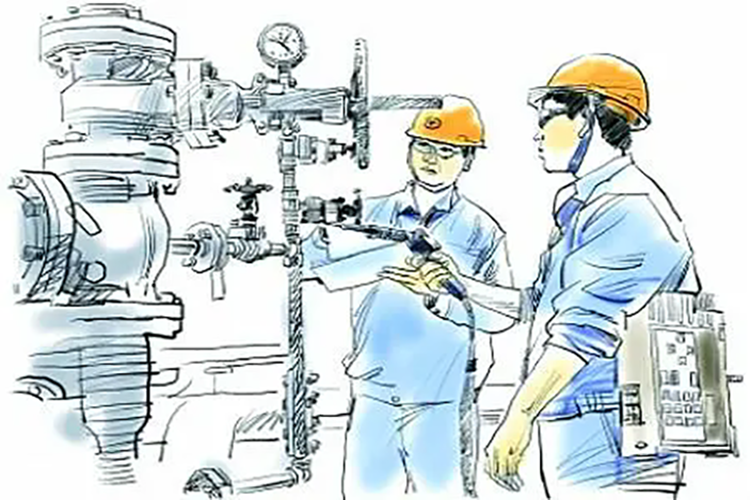

A water pump bearing may be designed for thousands—or tens of thousands—of operating hours, yet in some industrial pumps it develops excessive noise, temperature rise, vibration, or raceway damage far earlier than expected.

When this happens, the immediate conclusion is often:
“The bearing quality is poor.”
As a bearing manufacturer, however, we do not recommend beginning a failure investigation with that assumption.
In industrial centrifugal pumps, process pumps, cooling-water pumps, circulation pumps, and other rotating pump equipment, the bearing is part of a complete mechanical system. Its actual service life is influenced not only by bearing manufacturing quality, but also by load, lubrication, contamination, shaft and housing fits, alignment, hydraulic conditions, temperature, installation, and the bearing arrangement itself.
ISO 281 makes an important distinction here. Basic bearing rating life is a statistical fatigue-life calculation associated with 90% reliability under defined conventional conditions. Modified rating-life calculations additionally account for factors including lubrication and lubricant contamination. ISO 281 does not, however, treat wear, corrosion, or electrical erosion as part of the basic rating-life calculation.
This explains an important phenomenon we repeatedly see in the field:
A bearing can have sufficient calculated L10 life and still fail prematurely in the actual pump.
The correct question is therefore not simply, “How long should this bearing last?”
It is:
“What operating condition caused the actual bearing to deviate from its intended service environment?”
Below are ten of the most common causes.
1. Incorrect Lubrication
Lubrication is one of the first areas we examine when investigating premature pump-bearing damage.
A rolling bearing does not operate with the rolling elements continuously rubbing directly against the raceways. Under correct conditions, the lubricant creates a separating film between contacting surfaces.
The lubricant has several functions:
- separating rolling and sliding contact surfaces;
- reducing friction and wear;
- protecting surfaces against corrosion;
- helping exclude contaminants;
- and, in oil-lubricated systems, removing heat.
Schaeffler specifically identifies formation of a sufficiently load-carrying lubricant film as a fundamental lubrication function necessary to prevent wear and premature fatigue.
The problem is that “lubricated” does not necessarily mean “correctly lubricated.”
A pump bearing can suffer from:
- insufficient lubricant;
- excessive grease;
- incorrect grease consistency;
- unsuitable base-oil viscosity;
- incompatible grease mixing;
- degraded lubricant;
- incorrect oil level;
- unsuitable relubrication intervals.
Too little lubricant can result in insufficient film thickness and increased metal-to-metal interaction.
Too much grease can also create problems. Churning increases friction and temperature, which can accelerate lubricant degradation.
In an oil-lubricated pump, incorrect oil level is equally important. Too little oil may starve the bearing; excessive oil immersion can increase churning losses and operating temperature.
Solution: Select lubricant according to bearing type, speed, load, temperature, mounting arrangement, and operating environment—not simply because a particular grease has historically been used in the plant.
For critical pumps, lubrication should be treated as an engineering specification rather than a maintenance consumable.
2. Water and Process-Fluid Contamination
For industrial pumps, contamination deserves particular attention because the equipment itself is often operating next to water or another process fluid.
The bearing chamber should remain isolated from the pumped medium. If mechanical seals, labyrinths, isolators, housing seals, or other sealing elements deteriorate, moisture or process fluid can reach the bearing lubricant.
Water contamination is particularly damaging because it can simultaneously affect lubrication and corrosion protection.
Liquid contamination may degrade lubricant performance and reduce its ability to maintain an adequate lubricating film. SKF has documented that water and other liquid contaminants can degrade lubricant and contribute to increased temperature and metal-to-metal contact.
Once corrosion begins, damaged raceway surfaces become stress concentration sites. A bearing may subsequently show pitting or spalling even though the original problem began outside the bearing.
This creates an important diagnostic trap:
The visible bearing damage may be the final symptom—not the original cause.
Solution: When moisture is found inside a failed pump bearing, do not merely install another bearing. Investigate the sealing system, shaft surface, housing, drainage, storage conditions, condensation, and possible process-fluid ingress.
Replacing the bearing without eliminating the contamination path often results in repeated failure.
3. Solid-Particle Contamination
Water is not the only contaminant.
Dust, sand, casting residue, pipe-scale particles, rust, machining debris, seal fragments, and wear particles can enter an industrial pump bearing system during assembly, maintenance, lubrication, or operation.
Rolling contacts are especially sensitive because hard particles can be repeatedly overrolled between the rolling elements and raceways.
The result may include:
- indentations;
- increased local contact stress;
- abrasive wear;
- lubricant-film disruption;
- surface distress;
- accelerated fatigue.
SKF research on contamination has demonstrated why cleanliness matters so much: hard particles can plastically deform rolling-contact surfaces, leaving permanent indentations and significantly reducing subsequent bearing life.
This is why apparently insignificant contamination should not be dismissed.
The important relationship is not simply:
“Is the oil dirty?”
but rather:
Particle size and hardness vs. lubricant-film thickness and rolling-contact conditions.
Solution: Keep bearings, tools, shafts, housings, grease guns, oil containers, and assembly areas clean. For circulating-oil systems, appropriate filtration should be part of the lubrication-system design. Schaeffler notes that oil cleanliness has a considerable influence on bearing rating life and recommends filtration for relevant oil-lubricated arrangements.
4. Shaft Misalignment
Industrial pumps rarely operate as isolated machines. A typical installation includes:
Motor → coupling → pump shaft → bearing arrangement → impeller
If the motor and pump shafts are incorrectly aligned, additional forces are transmitted through the coupling and shaft system.
Misalignment may be:
- angular;
- parallel/offset;
- or a combination of both.
The resulting forces can alter the load distribution inside the bearings and create additional vibration and temperature rise.
A common maintenance mistake is to align the machine only when cold and assume the relationship remains unchanged during operation.
However, pumps, motors, piping, bases, and foundations can experience thermal growth. Pipe strain can also displace the pump casing after alignment has been completed.
Solution: Alignment should be checked as a system issue. Inspect coupling alignment, shaft condition, baseplate, soft foot, foundation, pipe strain, and thermal operating conditions.
If a replacement bearing repeatedly fails in the same position, alignment should be investigated before blaming successive bearings.
5. Incorrect Shaft and Housing Fits
A high-quality bearing installed on an incorrectly manufactured shaft or in an incorrectly dimensioned housing can still fail rapidly.
Bearing fits determine how the rings are supported and retained.
If the fit is too loose, the ring may creep relative to its seat, causing:
- fretting;
- wear;
- heat generation;
- loss of dimensional accuracy;
- vibration.
If the interference fit is excessive, another problem occurs:
The installed internal clearance can become smaller than intended.
For a radial bearing, expansion of the inner ring caused by a tight shaft fit—or compression of the outer ring caused by housing interference—changes the bearing’s internal geometry.
If this effect is combined with thermal expansion during pump operation, operating clearance may become too small.
The result can be:
higher friction → higher temperature → lower clearance → still higher friction.
Under severe conditions, this becomes a self-reinforcing thermal problem.
Solution: Do not select shaft and housing tolerances independently of bearing internal clearance. Shaft diameter, housing bore, geometrical accuracy, surface finish, material, temperature differential, and load direction must be considered together.
Simply replacing CN clearance with C3 is not a universal solution. The correct clearance must be determined from the actual fit and operating conditions.
6. Excessive or Unexpected Loads
Bearing selection begins with load—but the actual load experienced by a pump bearing can be very different from the load assumed during initial calculation.
Industrial pump bearings may experience both:
- radial loads, and
- axial/thrust loads.
The impeller and hydraulic system can generate axial thrust, while shaft mass, impeller forces, coupling conditions, belt drives in some designs, imbalance, and hydraulic instability contribute additional loading.
This matters greatly because bearing fatigue life is highly load-dependent.
Under ISO 281, basic rating life for rolling bearings is based on the relationship between the bearing’s basic dynamic load rating C and equivalent dynamic bearing load P. For ball bearings, the life exponent is 3; for roller bearings, the exponent is 10/3.
In simplified form:
Ball bearing:
L10 = (C/P)³
This has an important practical consequence.
Suppose the actual equivalent load increases by 25% while everything else remains unchanged:
New relative life = (1 / 1.25)³ ≈ 0.512
The theoretical basic life falls to roughly 51% of the original value.
A relatively modest increase in load can therefore have a disproportionately large effect on fatigue life.
Solution: If bearing failures recur, verify the real operating point of the pump rather than relying solely on original design assumptions. Check flow, head, impeller condition, axial thrust, shaft deflection, coupling forces, and any changes made to the pump system.
7. Cavitation and Hydraulic Instability
Cavitation is fundamentally a hydraulic problem, but its mechanical consequences can reach the bearings.
When local pressure falls sufficiently, vapor cavities can form in the liquid. Their subsequent collapse can generate pressure fluctuations, noise, vibration, and damage within the pump.
The bearing does not need to contact the fluid to be affected.
The transmission path is approximately:
Hydraulic instability → impeller excitation → shaft vibration/dynamic load → bearing
Therefore, replacing a bearing may temporarily remove the symptom while leaving the hydraulic cause untouched.
Possible contributors to cavitation include:
- insufficient NPSH margin;
- restricted suction piping;
- excessive pump speed;
- inappropriate operating point;
- high liquid temperature;
- suction-side flow disturbances.
Solution: If bearing damage occurs together with abnormal pump noise, unstable vibration, impeller erosion, or changes in process conditions, investigate hydraulic performance as well as the bearing.
A bearing manufacturer cannot solve a cavitation problem by supplying a higher-grade bearing alone.
8. Incorrect Bearing Selection or Bearing Arrangement
Not every industrial water pump should use the same bearing configuration.
Depending on pump architecture, speed, load direction, shaft arrangement, temperature, and thrust requirements, designers may use:
- deep-groove ball bearings;
- angular-contact ball bearings;
- double-row angular-contact bearings;
- cylindrical roller bearings;
- spherical roller bearings;
- paired bearing arrangements;
- or application-specific combinations.
A bearing can have adequate radial capacity but insufficient axial-load capability.
Conversely, a bearing arrangement may become over-constrained if both shaft ends are designed to locate the shaft axially without accommodating thermal expansion.
Industrial pump design therefore requires consideration of the entire bearing arrangement, not only an individual bearing’s catalog load rating.
Solution: Define the functions of the locating and non-locating bearing positions. Evaluate radial load, axial thrust direction, shaft thermal expansion, speed, stiffness, misalignment, required life, lubrication, and installation constraints before selecting the bearing arrangement.
When replacing an existing bearing, never assume that matching bore, outside diameter, and width alone guarantees suitability.
9. Incorrect Installation
A surprising number of bearing failures begin before the pump is ever started.
Typical installation errors include:
- transmitting mounting force through the rolling elements;
- hammering directly on the bearing;
- contaminating the bearing during installation;
- heating the bearing excessively;
- damaging seals;
- installing angular-contact bearings in the wrong orientation;
- incorrect locknut tightening;
- improper preload;
- damaging shaft or housing seats during removal.
Consider a simple example.
If an inner ring requires an interference fit on the shaft, mounting force should be applied appropriately to the inner ring.
If the installer presses on the outer ring while forcing the inner ring onto the shaft, mounting force may pass through:
Outer ring → rolling elements → raceways → inner ring
Those contact forces can damage precision raceway surfaces before operation begins.
The pump may run normally at first, making the installation damage difficult to recognize. The bearing then develops noise or spalling after a relatively short period.
Solution: Use correct mechanical, hydraulic, or thermal mounting methods and appropriate tooling. Installation personnel should understand which ring has the interference fit and how mounting force must be transmitted.
A bearing is a precision mechanical component. Installation should be treated accordingly.
10. Excessive Operating Temperature
When a pump bearing runs hot, temperature should be regarded as a diagnostic signal, not automatically as the root cause.
High bearing temperature can result from:
- excessive grease;
- insufficient lubrication;
- incorrect lubricant viscosity;
- excessive preload;
- insufficient operating clearance;
- excessive load;
- misalignment;
- excessive speed;
- seal friction;
- oil churning;
- external process heat.
Temperature also affects lubricant viscosity and grease life. Therefore, an initial mechanical problem can evolve into a lubrication problem.
For example:
Excessive interference → reduced clearance → increased friction → higher temperature → reduced lubricant viscosity → thinner lubricant film → further temperature increase
This is why simply switching to a “high-temperature bearing” or “high-temperature grease” can be the wrong corrective action.
Solution: Establish the normal operating-temperature baseline for the specific pump and monitor trends. A change from established baseline conditions is often more diagnostically useful than applying one universal temperature limit to every pump.
Investigate the complete chain of causes before changing bearing specifications.
What Does a Failed Pump Bearing Actually Tell Us?
When we receive a failed industrial pump bearing for analysis, we do not begin by asking only:
“How many hours did it run?”
We want to know:
- Where is the damage located?
- What does the raceway running pattern look like?
- Is there discoloration?
- Is corrosion present?
- Are there indentations?
- What is the grease or oil condition?
- Is the damage symmetrical?
- Which ring rotated relative to the load?
- What were the shaft and housing fits?
- What was the actual operating temperature?
- Did vibration increase before failure?
- Was the mechanical seal leaking?
- Were operating conditions changed?
- Was the pump recently rebuilt?
These clues help distinguish fatigue from lubrication failure, contamination, corrosion, incorrect fitting, overload, or misalignment.
This distinction matters because replacing the failed bearing without determining the root cause can simply restart the same failure cycle.
Bearing Life Is Not Just a Number in a Catalog
A bearing catalog may provide dynamic load rating, limiting speed, reference speed, dimensions, and other technical parameters. These are necessary for selection, but they do not independently predict the actual life of an industrial pump.
ISO 281 itself reflects this distinction. Basic rating life is associated with defined conventional conditions and 90% reliability, while modified rating life can account for lubrication, contamination, and other factors.
In practical pump engineering, we can think of bearing reliability as a system:
Bearing design and manufacturing quality
Correct bearing selection
Correct shaft/housing design
Correct installation
Adequate lubrication
Effective sealing and cleanliness
Proper alignment
Stable hydraulic operation
Reliable bearing service
If one element is wrong, simply purchasing a bearing with a higher dynamic load rating may not solve the problem.
A Practical Troubleshooting Guide
| Observed symptom | Possible causes to investigate |
|---|---|
| Bearing temperature rising | Lubrication, excessive grease, clearance, preload, fit, misalignment, load |
| Raceway corrosion | Water ingress, condensation, process-fluid contamination, storage |
| Early raceway spalling | Contamination, overload, misalignment, installation damage, inadequate lubrication |
| Repeated failure at same bearing position | Alignment, housing geometry, shaft geometry, load distribution, lubrication system |
| Excessive vibration | Imbalance, misalignment, cavitation, looseness, bearing damage |
| Grease discoloration/degradation | Temperature, contamination, oxidation, incompatible grease |
| Fretting on bearing seat | Loose fit, creep, insufficient support |
| Damage after recent overhaul | Installation, cleanliness, alignment, incorrect bearing arrangement |
| Bearing failure accompanied by seal leakage | Mechanical seal/sealing system should be investigated |
| New bearing repeatedly runs hot | Fit, operating clearance, preload, lubrication quantity, alignment |
The table should be used as a diagnostic starting point, not as a one-symptom/one-cause failure chart. Several failure mechanisms can produce similar visible symptoms.
Final Thoughts from a Bearing Manufacturer
When an industrial water pump bearing fails prematurely, replacing it is relatively easy.
Finding why it failed is the more important engineering task.
In our experience as a bearing manufacturer, a responsible failure analysis should distinguish between three fundamentally different questions:
Was the bearing itself defective?
Was the bearing incorrectly selected or installed?
Or did an external pump-system condition cause the bearing damage?
The answer determines the correct corrective action.
If contamination caused the failure, improve sealing and cleanliness.
If insufficient lubrication caused it, correct the lubrication specification or delivery method.
If misalignment caused it, correct the machine alignment.
If excessive hydraulic load caused it, investigate the pump operating condition.
If insufficient internal clearance caused it, evaluate fits, thermal conditions, and clearance selection.
And if metallurgical, dimensional, heat-treatment, raceway, or manufacturing defects are confirmed, then the bearing itself must be investigated.
This distinction prevents an expensive maintenance pattern:
Failure → Replace Bearing → Restart Pump → Same Root Cause Remains → Failure Again
A better approach is:
Failure → Preserve Evidence → Inspect → Identify Failure Mode → Determine Root Cause → Correct System Condition → Replace Bearing → Monitor
That is the difference between simply replacing a bearing and solving a reliability problem.
Technical References
This article is based on established rolling-bearing engineering principles, including ISO 281:2007 — Rolling bearings — Dynamic load ratings and rating life, which remains the published ISO standard while a new edition is under development.
Lubrication principles and the importance of lubricant-film formation, contamination control, corrosion protection, oil filtration, and operating conditions are consistent with technical guidance published by Schaeffler.
SKF technical literature and published engineering cases likewise document the major roles of contamination, water ingress, lubrication, mounting, misalignment, and excessive loading in premature rolling-bearing damage.