
Share the most optimized bearing application solutions,
professional bearing knowledge and industry news

*Please enter the relevant terms or keywords you need to consult, and relevant articles will appear in the search results. If you can’t find the answer you need, please feel free to contact us and we will serve you wholeheartedly. Or you can send an email directly to sales@vkuken.com

Bearing Technology
Technology
Bearing technology training
Training
Bearing solutions
solutions
How to Quantitatively Analyze Wear of Slewing Bearings to Determine Repair and Replacement Timing
Quantitative evaluation of slewing bearing wear should focus on four core rotational accuracy indicators: bearing clearance, axial runout, radial runout, and gear runout. Among them, bearing clearance is the most direct and critical measure of wear progression. When clearance exceeds twice the design limit, maintenance is required; exceeding three times the limit indicates the need for replacement preparation. After installation, gear tooth contact pattern analysis becomes the most practical monitoring method. Combined with abnormal noise, metallic debris in grease, or rotational irregularities, these indicators provide a reliable basis for determining repair and replacement timing and for planning spare bearing procurement in advance.
Table of Contents
    Add a header to begin generating the table of contents

    There are various opinions and reference standards regarding how to quantitatively analyze the wear of slewing bearings (turntable bearings) in order to determine appropriate timing for repair or replacement. As a guiding recommendation, many technical documents or manuals are either vague, overly obscure, or even fabricate certain technical indicators.

    In actual production and condition monitoring of slewing bearing wear, it is extremely difficult to achieve effective measurement. As a result, many inspections become merely formalities—performance indicators may look acceptable on paper, but are very difficult to implement in practice.

    To evaluate the rotational accuracy of slewing bearings, four key indicators are generally used:

    • Axial runout (face runout)
    • Radial runout
    • Maximum gear runout (tooth runout peak)
    • Bearing clearance

    Therefore, in simple terms, evaluating the wear of a slewing bearing essentially means monitoring these four precision and rotational accuracy indicators.

    Among these four indicators, those that directly reflect slewing bearing wear are bearing clearance, axial runout, radial runout, and gear runout. Fundamentally, all of them have a causal relationship with multiple bearing performance parameters. Consequently, monitoring bearing clearance is the most critical priority.
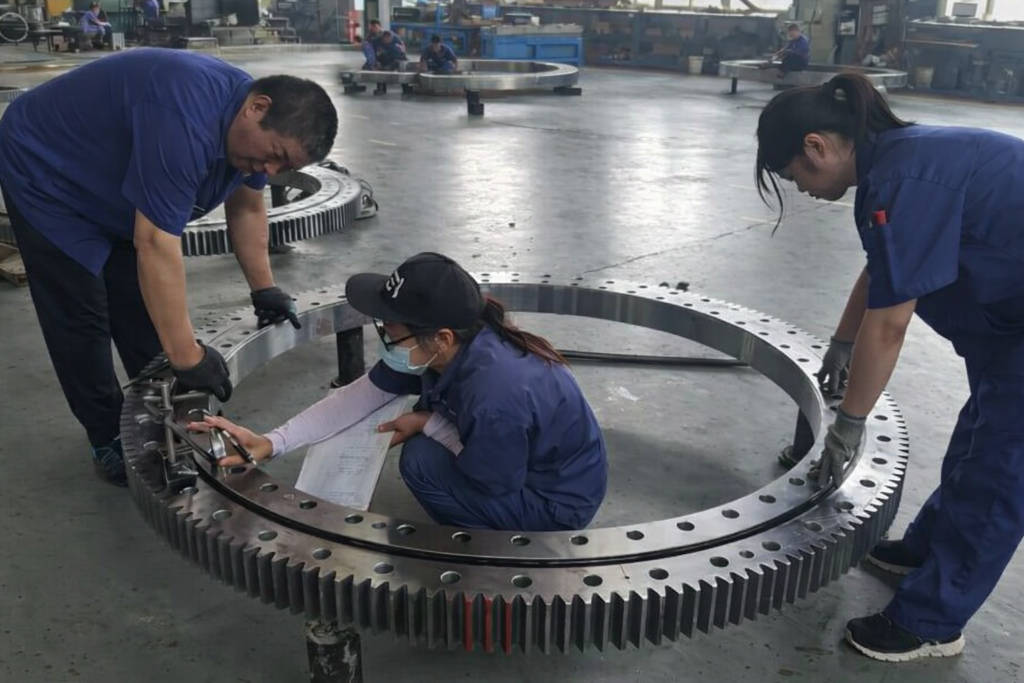
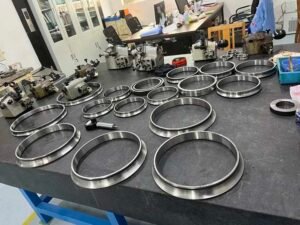
    The figure above shows comprehensive bearing clearance inspection and recording performed before the bearing leaves the factory.

    Using bearing clearance as the benchmark for wear evaluation, if the drawing specifies a clearance range of 0.15–0.35 mm, then 0.35 mm represents the maximum allowable clearance under design conditions.

    • When the measured clearance exceeds twice the maximum value (approximately 0.7 mm), the bearing requires maintenance and repair.
    • When the clearance exceeds three times the maximum value (approximately 1.0 mm), preparation for new bearing replacement is required.

    In addition, axial runout and radial runout are also critical inspection items, as they indicate the flatness deviation and roundness condition of the bearing.
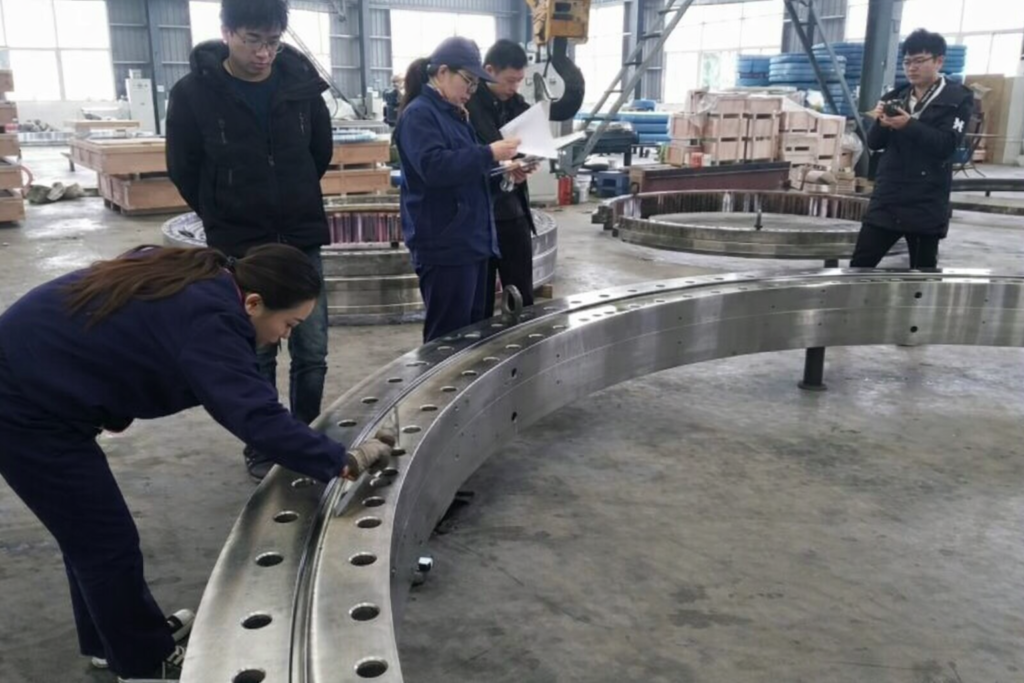
    After the bearing is installed on the machine, it is very difficult to measure these four indicators as freely and comprehensively as in a factory environment. In many cases, after installation, only a limited portion of the bearing—such as the section meshing with the pinion—can be observed, which represents only the “tip of the iceberg.”

    Therefore, when rotational accuracy cannot be directly measured after installation, the most straightforward inspection method is to evaluate the gear tooth contact pattern. As an acceptance criterion, along the vertical line of contact at the gear pitch circle, the contact area should be vertically centered, evenly distributed, and cover 40%–70% of the tooth surface, which indicates a healthy condition.

    If, after installation, the contact pattern is abnormal—and after excluding factors such as installation errors, improper adjustment, foundation settlement, or structural deformation—then changes in bearing wear must be considered.

    At this stage, if additional symptoms occur, such as abnormal noise during rotation, unidentified metallic particles in the grease, jamming, unsmooth rotation, or dead spots, the bearing must definitely be prepared for replacement in advance. It is strongly recommended to procure a new bearing at least 90 days in advance to avoid unexpected downtime.

    Hi, I am Maxwell, I am an engineer in the field of bearing applications. I majored in mechanical and electromechanical engineering during college. After graduation, I worked for the top three “SKF” bearing companies in the world for ten years. , during which I went to dozens of customers in different industries to help them solve problems in bearing applications; later I joined “vkuken” Bearing Manufacturing, and I will share bearing technical knowledge on this website from time to time. If you are a customer Please contact me to help you solve your problem; if you are also a technical expert in bearings, I am very willing to exchange technical knowledge about bearings with you.

    Exclusive solutions

    Steelworker at work near the tanks with hot metal
    Metallurgical equipment bearing solutions
    road construction
    Construction Machinery bearing solutions
    Vibrating Screen Equipment bearing solutions
    Transmission Equipment bearing solutions
    Coal mining in an open pit
    Mining Equipment bearing solutions
    Industrial robots
    industrial robot bearing solutions
    Latest Articles
    Misunderstandings about bearing installation

    Proper bearing installation is essential for optimal performance and longevity. Common mistakes include using excessive force, which can damage internal components, and neglecting cleanliness, as

    Read More »
    Why more and more customers choose to cooperate with VKUKEN bearing for long time?

    When customers choose VKUKEN for the first time, it may be a trial. When customers choose VKUKEN for a long time, it must be that they have obtained satisfactory value.

    Latest Projects
    Mixer truck bearings
    Mixer truck bearings
    Vibrating screen bearings
    Vibrating screen bearings
    Metallurgical equipment bearings
    Metallurgical equipment bearings
    Rolling mill bearings
    Rolling mill bearings
    Vibrating screen bearings
    Vibrating screen bearings
    Food machinery bearings
    Food machinery bearings
    Chemical Machinery Bearings
    Chemical Machinery Bearings
    Textile machinery bearings
    Textile machinery bearings

    * vkuken takes your privacy seriously. All information is used for technical and commercial communication only and will not be disclosed to third parties. If you are interested in more bearing technology, you can click on this article for reference.

    Our team knows that every customer inquiry is very important; our professional engineers will reply to you within 24H.

    “Your contact information will be kept absolutely confidential and will not be disclosed.”

    Inquire now