Skip to content


Why Bearing Suffixes Matter
As a bearing application engineer, I answer technical inquiries from customers every day. Surprisingly, one question appears far more often than any other:
“What does the suffix after the bearing number mean?”
Another common situation is that customers send an inquiry containing only the basic bearing designation.
For example:
6205
or
6310
or
22218
Then they simply ask,
“Please quote your best price.”
Unfortunately, this information is often incomplete.
The basic bearing number tells us the bearing type and dimensions, but it does not define the complete specification.
For example, all of the following bearings share exactly the same dimensions:
- 6205
- 6205-Z
- 6205-ZZ
- 6205-2RS
- 6205-C3
- 6205-P5
- 6205-M
- 6205-NR
However, they are completely different products.
Some are suitable for dusty environments.
Some are designed for high-speed electric motors.
Some are manufactured for precision machine tools.
Others are intended for high-temperature applications.
A difference of just two letters can completely change the bearing’s performance.
That is why every professional bearing manufacturer always recommends ordering bearings by their complete designation, including all suffixes.
Understanding the Structure of a Bearing Model Number
Before discussing suffixes, let’s first understand how a typical bearing model is constructed.
Example:
6205-2RS-C3
This designation can be divided into three sections.
| Part | Meaning |
| 6205 | Basic bearing designation |
| 2RS | Double rubber seals |
| C3 | Internal clearance larger than normal |
Another example:
6312-ZZ-P5-M
| Part | Meaning |
| 6312 | Basic bearing type and dimensions |
| ZZ | Double metal shields |
| P5 | High precision class |
| M | Machined brass cage |
Once you understand this structure, identifying bearing specifications becomes much easier.
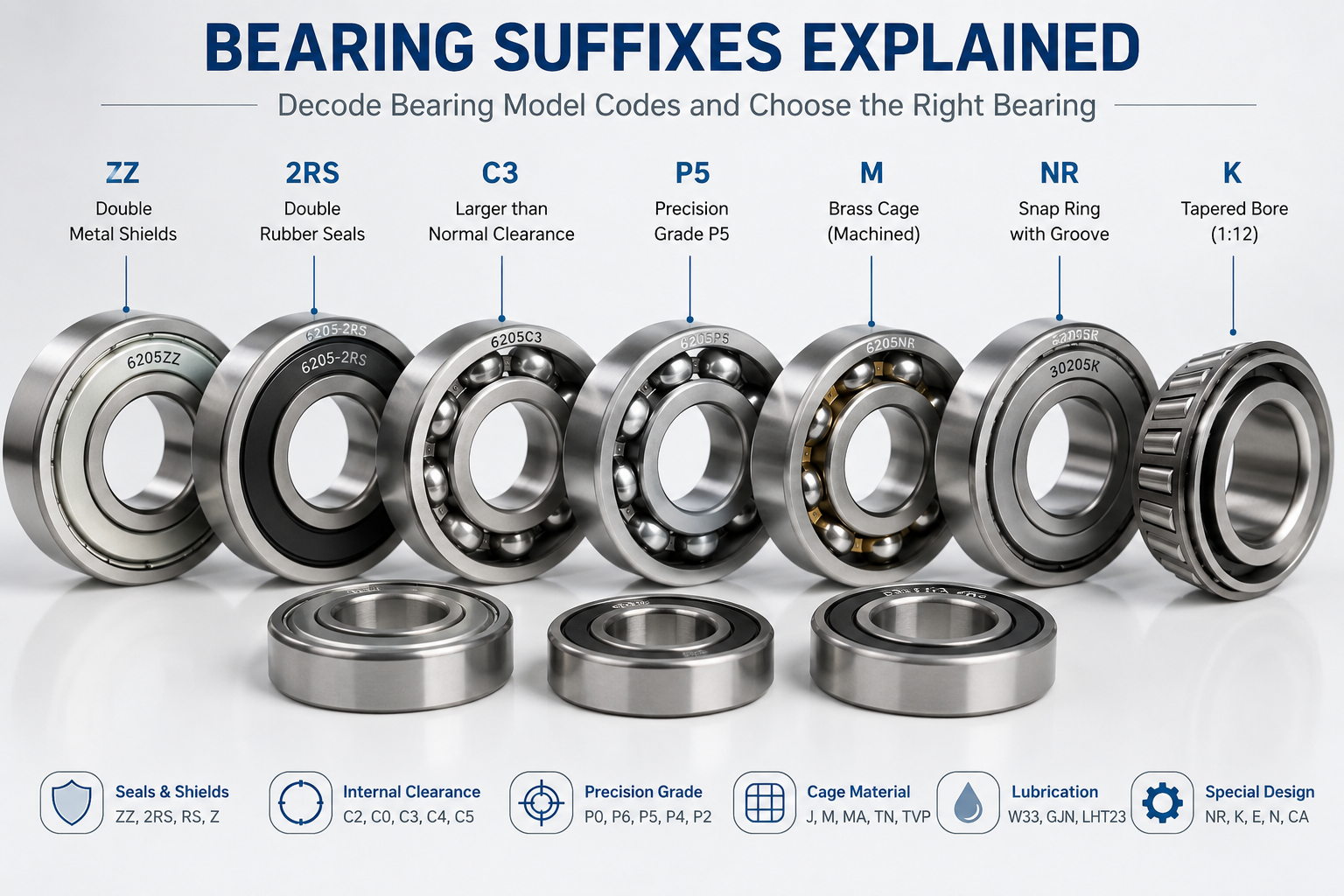
1. Shield and Seal Suffixes
One of the first suffixes buyers notice is the sealing type.
Many customers ask me:
“What is the difference between ZZ and 2RS?”
Although both prevent contaminants from entering the bearing, they serve different purposes.
| Suffix | Description | Contact Type | Typical Application |
| Z | One metal shield | Non-contact | High-speed motors |
| ZZ (2Z) | Two metal shields | Non-contact | Electric motors, fans |
| RS | One rubber seal | Contact | General machinery |
| 2RS | Two rubber seals | Contact | Pumps, agriculture, construction |
| RZ | One low-friction seal | Light contact | High-speed equipment |
| 2RZ | Double low-friction seals | Light contact | Precision machinery |
Metal Shield (ZZ)
Advantages
- Lower running torque
- Higher speed capability
- Lower operating temperature
Disadvantages
- Limited protection against water
- Not suitable for muddy environments
Typical applications
- Electric motors
- Cooling fans
- Machine tools
- Household appliances
Rubber Seal (2RS)
Advantages
- Excellent dust protection
- Water resistant
- Better grease retention
Disadvantages
- Slightly higher friction
- Lower maximum speed
Typical applications
- Agricultural machinery
- Mining equipment
- Automotive wheel hubs
- Food processing equipment
Selection Tip
If speed is your priority, choose ZZ.
If contamination protection is more important, choose 2RS.
2. Internal Clearance Suffixes
Internal clearance is one of the most misunderstood bearing specifications.
It refers to the small amount of internal movement between the rolling elements and raceways before installation.
| Suffix | Clearance |
| C2 | Smaller than normal |
| CN (C0) | Normal clearance |
| C3 | Greater than normal |
| C4 | Much greater than normal |
| C5 | Extremely large clearance |
When should C3 bearings be selected?
I usually recommend C3 bearings for:
- Electric motors
- Pumps
- Gearboxes
- High-speed applications
- Bearings operating at elevated temperatures
The larger clearance compensates for thermal expansion during operation.
Choosing excessive clearance for low-speed applications may increase vibration and noise.
3. Precision Grade Suffixes
Precision determines manufacturing accuracy.
The higher the precision grade, the tighter the tolerances.
| Suffix | Precision Level | Typical Equipment |
| P0 | Standard | General machinery |
| P6 | Higher accuracy | Industrial equipment |
| P5 | Precision | Servo motors, CNC machines |
| P4 | High precision | Machine tool spindles |
| P2 | Ultra precision | Aerospace, precision grinding |
Many customers request P5 bearings without actually requiring that level of precision.
For ordinary conveyor systems or agricultural equipment, standard P0 bearings are often the most economical solution.
4. Cage Material Suffixes
The cage keeps rolling elements evenly spaced.
Its material greatly affects bearing performance.
| Suffix | Cage Material |
| J | Pressed steel cage |
| M | Machined brass cage |
| MA | Brass cage with modified design |
| TN | Polyamide cage |
| TN9 | Glass-fiber reinforced polyamide |
| TVP | Reinforced polymer cage |
Generally speaking:
- Steel cages are economical.
- Brass cages perform well under heavy loads.
- Polyamide cages are lighter and quieter at high speed.
5. Lubrication Suffixes
Some suffixes specify lubrication grooves or factory-filled grease.
Common examples include:
| Suffix | Description |
| W33 | Lubrication groove and oil holes |
| GJN | High-temperature grease |
| VT143 | Electric motor grease |
| LHT23 | Low-temperature grease |
Different manufacturers may use different lubrication suffixes.
Always refer to the manufacturer’s catalog before ordering.
6. Special Design Suffixes
These suffixes define unique structural features.
| Suffix | Meaning |
| NR | Snap ring groove with retaining ring |
| N | Snap ring groove only |
| K | Tapered bore (1:12) |
| K30 | Tapered bore (1:30) |
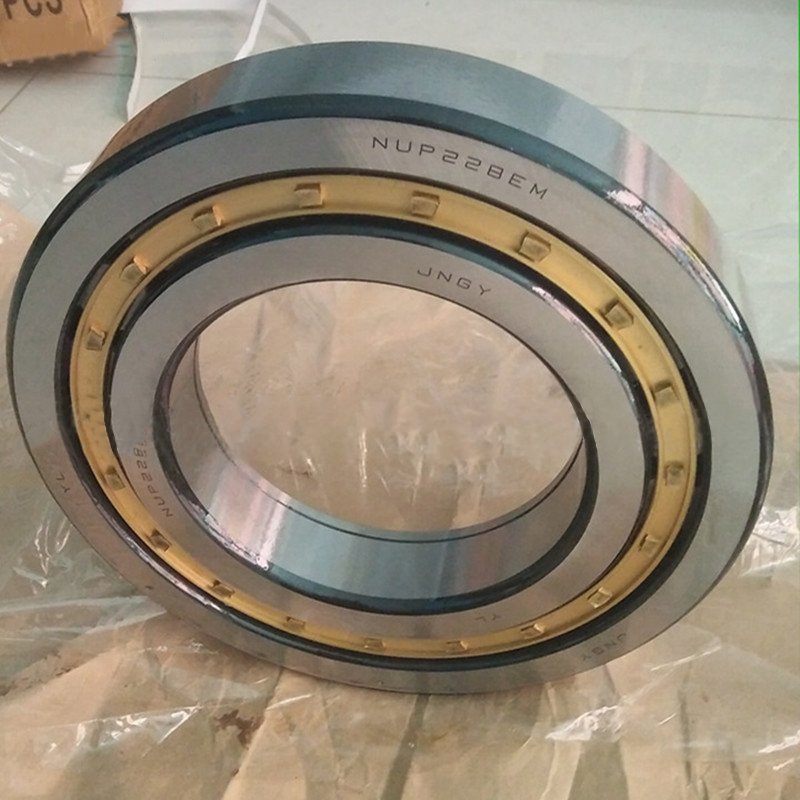
| E | Reinforced internal design |
| EM | Reinforced design with brass cage |
| CA | Brass cage for spherical roller bearings |
| CC | Pressed steel cage for spherical roller bearings |
These suffixes are particularly common in spherical roller bearings and large industrial bearings.
7. Manufacturer-Specific Suffixes
One important fact many buyers overlook is that bearing suffixes are not completely universal.
For example, SKF, FAG, NSK, NTN, KOYO, TIMKEN, and other manufacturers all follow international standards for many suffixes, but they also use proprietary suffixes for specific cage designs, lubrication systems, heat treatment processes, vibration classes, and internal modifications.
For example, a suffix used by SKF may represent a grease specification, while a similar-looking suffix from another manufacturer may indicate a completely different feature.
Whenever you are replacing a bearing from a different brand, avoid assuming that every suffix has the same meaning. Always compare the manufacturer’s technical catalog or consult your bearing supplier before placing an order.
100+ Common Bearing Suffix Quick Reference
Below are some of the most frequently encountered suffixes in daily engineering practice.
| Suffix | Meaning |
| Z | Single metal shield |
| ZZ (2Z) | Double metal shields |
| RS | Single rubber seal |
| 2RS | Double rubber seals |
| C2 | Reduced internal clearance |
| CN (C0) | Normal internal clearance |
| C3 | Greater internal clearance |
| C4 | Extra internal clearance |
| C5 | Maximum internal clearance |
| P6 | Higher precision |
| P5 | Precision grade |
| P4 | High precision |
| P2 | Ultra precision |
| J | Steel cage |
| M | Brass cage |
| MA | Machined brass cage |
| TN | Polyamide cage |
| W33 | Lubrication groove and holes |
| NR | Snap ring with retaining ring |
| N | Snap ring groove |
| K | Tapered bore (1:12) |
| K30 | Tapered bore (1:30) |
| E | Reinforced internal design |
| EM | Reinforced design with brass cage |
| CA | Brass cage for spherical roller bearings |
| CC | Steel cage for spherical roller bearings |
Frequently Asked Questions
Can I replace a ZZ bearing with a 2RS bearing?
In many applications, yes. However, the maximum speed, friction, and sealing performance will change. Always evaluate the operating conditions before making a substitution.
Is a C3 bearing always better than a normal bearing?
No. C3 bearings are designed for applications where thermal expansion or high speed requires additional internal clearance. Using C3 in low-speed or lightly loaded equipment may increase noise and vibration.
Are bearing suffixes the same for every manufacturer?
Not entirely. Many common suffixes follow international conventions, but major manufacturers also use proprietary suffixes for lubrication, cage design, heat treatment, and other special features. Always verify the suffix definitions in the manufacturer’s catalog.
Why do customers often omit bearing suffixes in inquiries?
In many cases, the suffix is not visible on old bearings, or the customer is unaware of its significance. Providing the complete bearing designation helps manufacturers quote the correct product and reduces the risk of ordering errors.
Conclusion
Although bearing suffixes may seem like minor additions to a model number, they define many of the characteristics that determine how a bearing performs in real-world applications. A few letters can specify the sealing method, internal clearance, precision grade, cage material, lubrication, or special structural features. Selecting the wrong suffix may lead to installation problems, reduced service life, or unnecessary maintenance costs.
Whenever possible, provide the complete bearing designation when requesting a quotation. If the suffix is missing or unreadable, consult your bearing supplier before placing an order. A correct bearing specification is the first step toward reliable equipment performance and long service life.