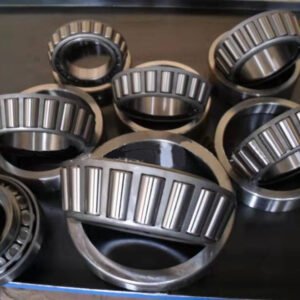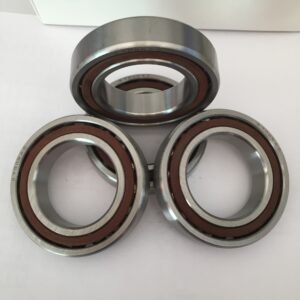

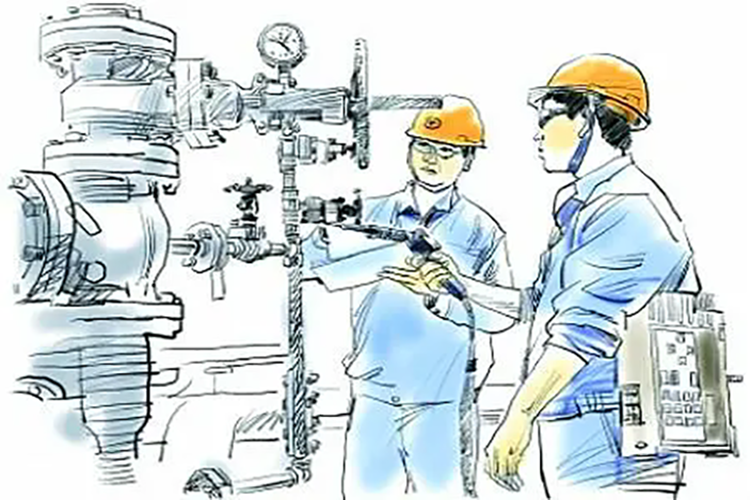

In some cases, customers require custom bearings but are unable to provide design drawings. For bearing engineers, one critical task is on-site reverse measurement. When standard parameters and formal drawings are unavailable, engineers must disassemble the old bearing, measure it directly, and recreate accurate technical drawings.
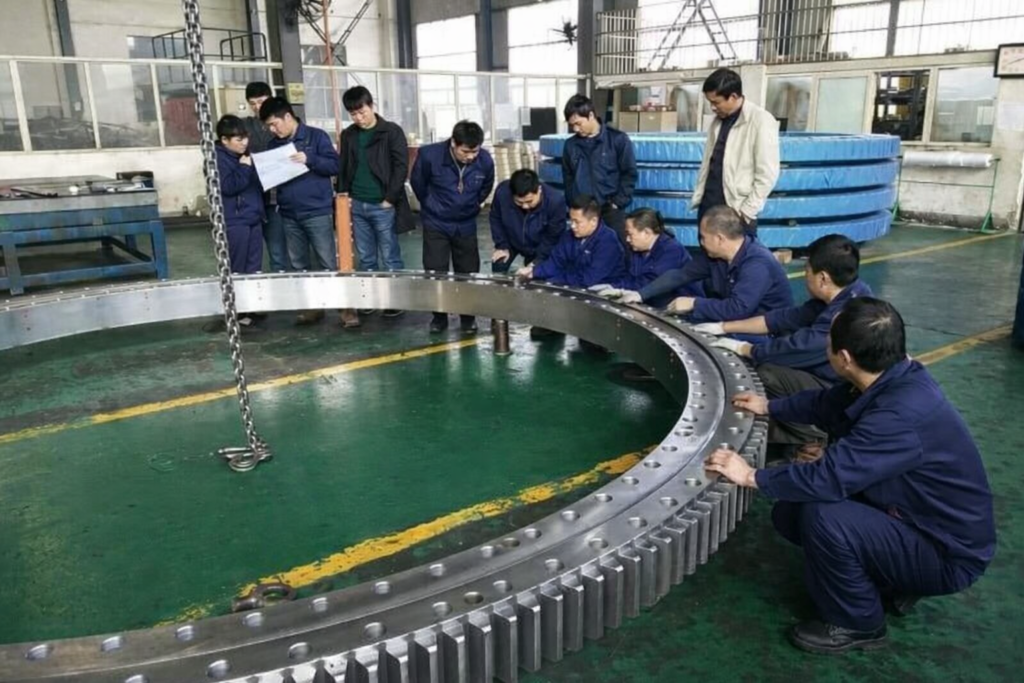
When measuring a bearing, the first priority is to confirm three core data sets, as these directly affect installation compatibility and must be handled with strict precision.
1. Overall Dimensions
First, verify the overall dimensions, including:
- Outer diameter
- Inner diameter
- Total height
- Any height differences or steps
These dimensions determine whether the bearing can be installed correctly in the existing equipment.
2. Mounting Hole Parameters
Next, confirm all mounting hole data, including hole chord length, which is calculated as follows:
Chord length = Pitch circle diameter × sin (180° ÷ number of holes)
Example: Crane slewing bearing model 2890
Outer ring pitch circle diameter: 3005 mm, 60 holes Ø39
Inner ring pitch circle diameter: 2775 mm, 60 holes M36
Calculated results:
Outer ring hole chord length:
3005 × sin (180° ÷ 60) = 157.27 mm
Inner ring hole chord length:
2775 × sin (180° ÷ 60) = 145.23 mm
During actual measurement, attention must be paid to adding or subtracting one hole diameter to ensure accuracy.
3. Gear Parameters
Gear measurement is the second key step:
- Confirm the exact number of teeth
- Estimate the gear module
- Measure the distance from tooth root to tooth tip using a depth gauge
The module is calculated as:
m = (Tooth root–to–tooth tip height) ÷ 2.225
4. Spigot, Step, and Lubrication Details
Finally, measure the following auxiliary but critical features:
Spigot (locating shoulder) dimensions
Step dimensions
Oil hole specifications
Lubrication hole positions and distribution
All of the above parameters are essential for accurate bearing reverse engineering. Measurements must be performed using professional measuring tools and executed by experienced bearing engineers to ensure reliability and performance.