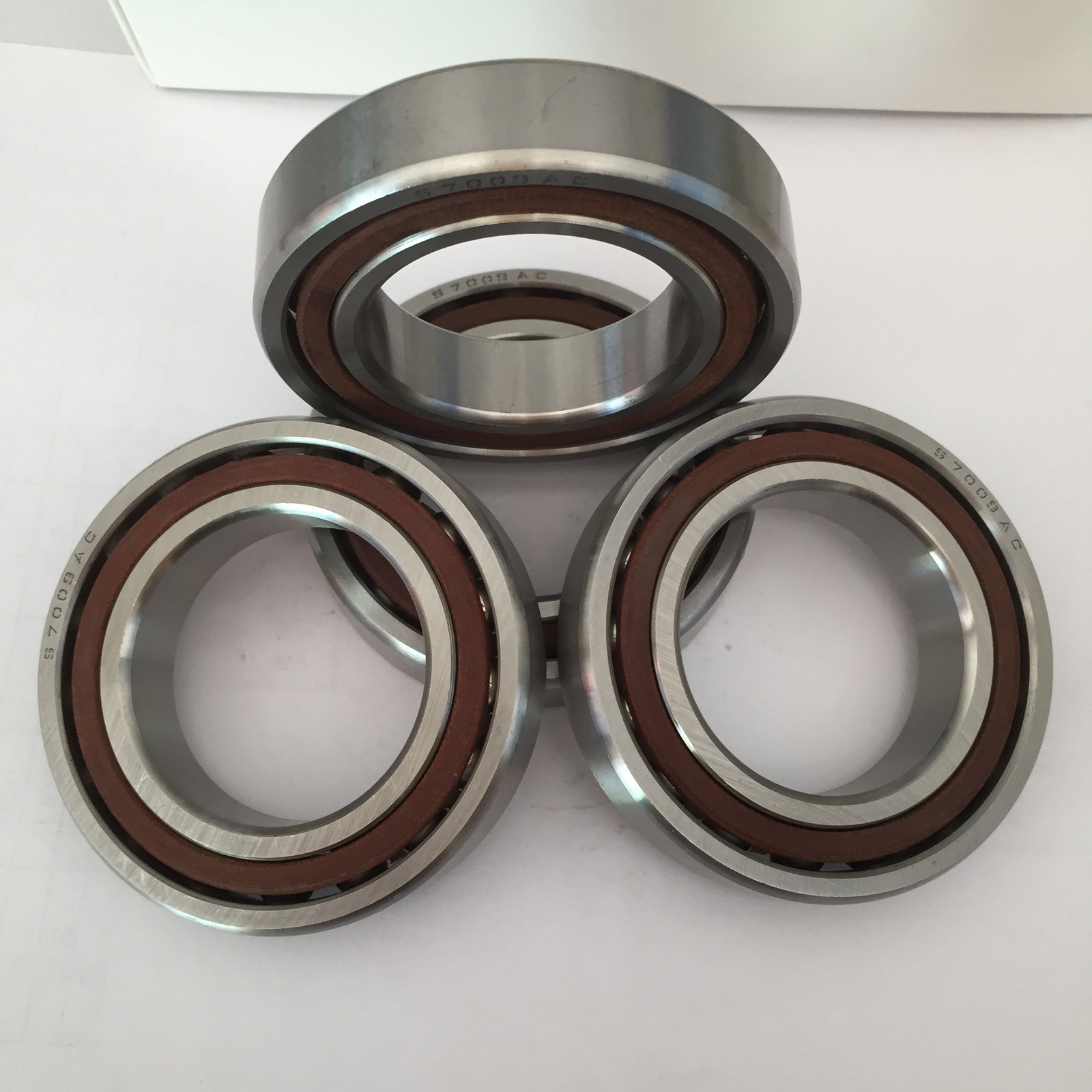
Angular contact ball bearings are high-precision bearings in which the inner and outer raceways are offset relative to each other along the axial direction. Their key feature is that the line connecting the contact points of the balls and raceways forms a specific angle with the perpendicular line to the bearing axis (typically 15°, 25°, or 40°).
They are specifically designed to withstand both radial loads and combined unidirectional axial loads, offering high speeds, high rigidity, and excellent axial load capacity.
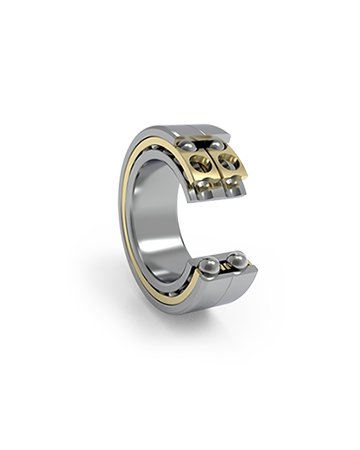
From an engineering configuration perspective, there are three primary combination arrangements for single-row Angular Contact Ball Bearings.
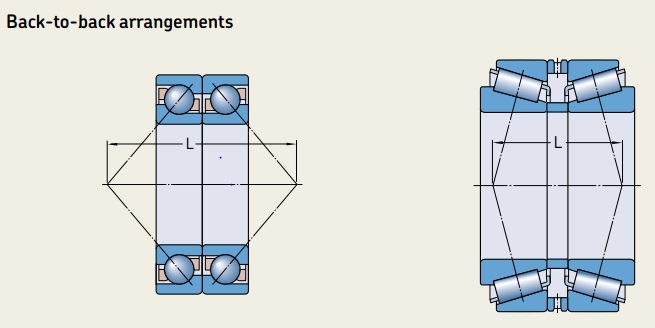
Structural Concept
The contact angles diverge outward, forming a wide support base.
Mechanical Characteristics
High moment stiffness
High tilting rigidity
Good support for overturning moments
Suitable for high-speed and high-precision systems
Typical Applications
Machine tool spindles
High-speed motors
Precision equipment
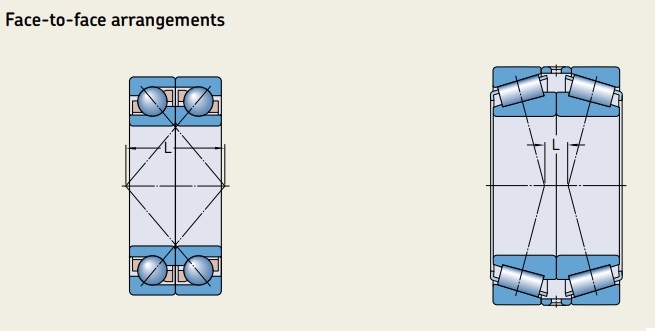
Structural Concept
The contact angles converge toward the shaft center.
Mechanical Characteristics
Better tolerance to misalignment
Slightly lower moment stiffness than DB
More forgiving under housing distortion
Applications with possible shaft deflection
Systems with moderate precision requirements
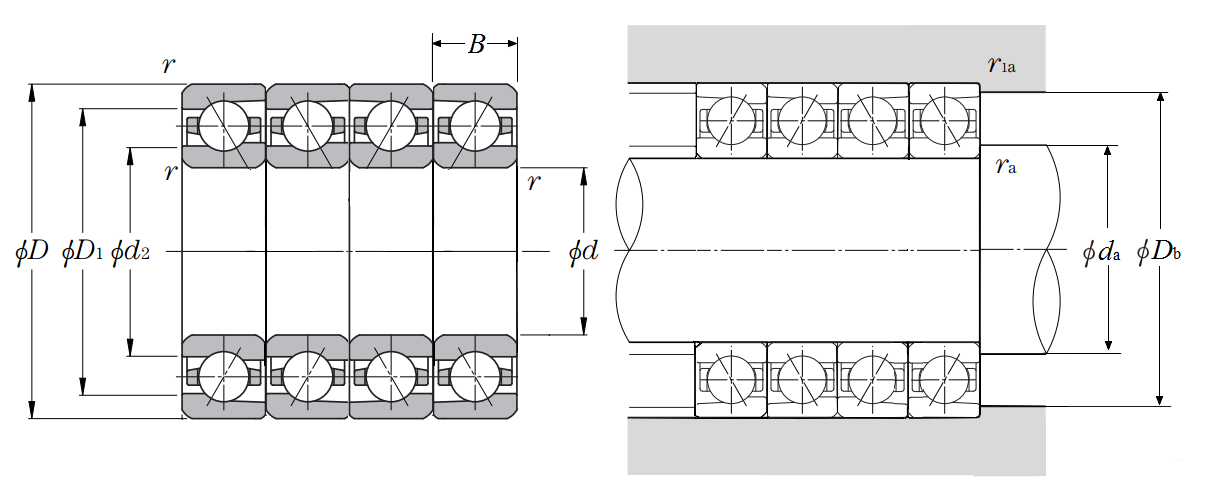
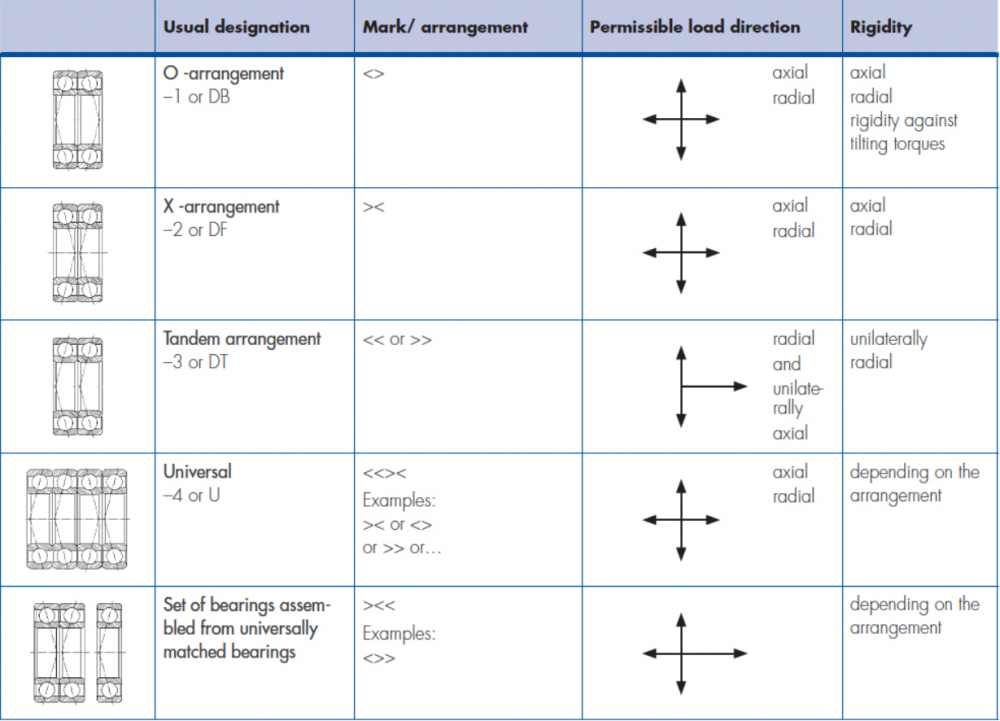
Structural Concept
Bearings are mounted in the same direction.
Mechanical Characteristics
Axial load capacity increases proportionally
Cannot support axial load in the opposite direction
Requires an additional bearing for bidirectional axial load
Typical Applications
High axial load systems
Pumps and compressors
Heavy thrust applications
Characteristics
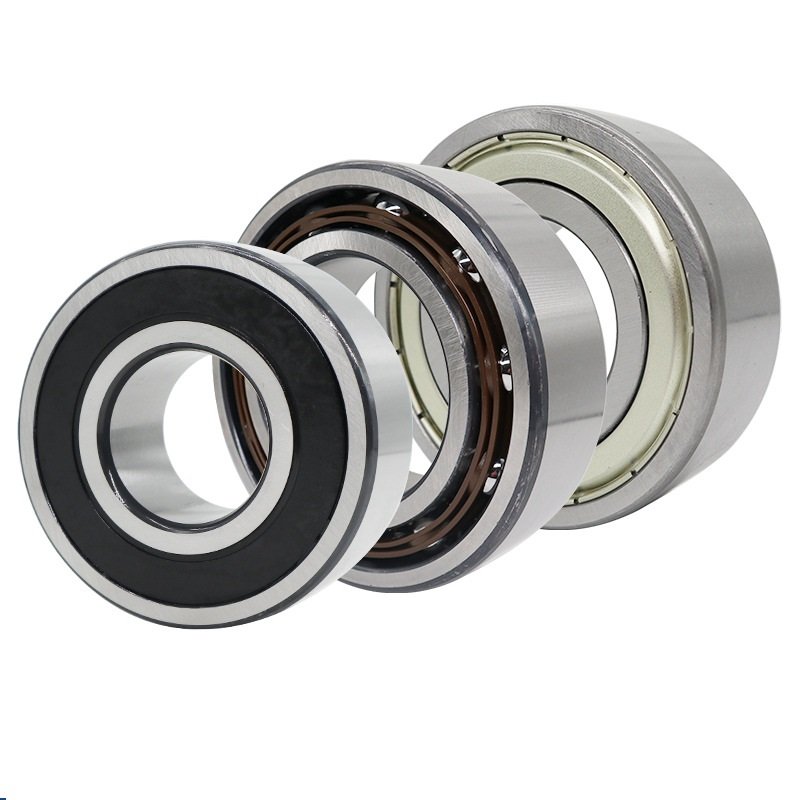
No integrated seals or shields
Designed for external lubrication (grease or oil)
Common in high-precision and high-speed systems
Typical Applications
Machine tool spindles
High-speed motors
Industrial gear systems
Pumps and compressors
Characteristics
Integrated contact (2RS) or non-contact seals
Pre-filled with grease
Maintenance-reduced design
Seal Materials
NBR (standard temperature)
FKM/Viton (high temperature)
Steel-reinforced seal structure
Typical Applications
Electric motors
Agricultural equipment
Conveyor systems
General industrial machinery
Function
Mounted on the shaft
Transfers load from shaft to rolling elements
Defines the contact angle geometry
Through-hardened
Hardness: 58–64 HRC
Excellent rolling contact fatigue resistance
High dimensional stability
Optional Materials
Carburized Alloy Steel (20CrMnTi / SAE 8620) – heavy-duty or shock load
Martensitic Stainless Steel (AISI 440C) – corrosive environments
Function
Mounted in the housing
Receives load from rolling elements
Forms inclined contact path
Standard Material
GCr15 / 100Cr6 Bearing SteelThrough-hardened
High wear resistance
High surface finish
Enhanced Option
Vacuum-degassed clean steel – improved fatigue life
Stainless steel (440C) – moisture or chemical exposure
Function
Carry radial and axial loads
Enable rolling motion
Transmit force along inclined contact angle
Standard Material
Chrome Steel Balls (GCr15 / 52100)Precision grade (G5–G40 depending on class)
High hardness and surface finish
Optional Materials
Stainless Steel Balls (440C)
Corrosion resistance
Lower density
High-speed capability
Electrical insulation
Reduced centrifugal force
Used in hybrid angular contact bearings for high-speed spindles.
Function
Maintains ball spacing
Reduces friction and collision
Guides rolling elements
Common Materials
Pressed Steel Cage
Low-carbon steel (SPCC / DC01)
Economical
Suitable for general industrial use
Machined Brass Cage (CuZn Alloy)
High strength
Good sliding characteristics
Suitable for higher speeds and loads
Polyamide Cage (PA66 + Glass Fiber)
Lightweight
Low noise
Ideal for high-speed motor applications
Cage selection depends on speed factor (n × dm), temperature, and preload conditions.
Function
Protect against contamination
Retain lubricant
Materials
Rubber Contact Seal (2RS)
NBR (standard temperature)
FKM/Viton (high temperature)
Steel reinforcement insert
Low-carbon steel
Zinc or phosphate coated
Material properties depend strongly on heat treatment.
Heat Treatment
Through-hardening (standard)
Carburizing (heavy-duty applications)
Controlled quenching for dimensional stability
Optional Surface Enhancements
Black oxide coating
Phosphate coating
Special low-friction coatings (DLC for advanced applications)

The specifications of angular contact ball bearings mainly include the inner diameter (d), outer diameter (D), width (B), and basic rated dynamic/static load (Cr/C0r). Commonly used series include 7000, 7200, and 7300, with contact angles of 15° (C), 25° (AC), and 40° (B).
Overview of common dimensions for single-row angular contact ball bearings (using ISO standards as an example):
| Bearing Model | Inner Diameter (d) mm | Outer Diameter (D) mm | Width (B) mm | Contact Angle | Notes (Typical Series) |
| 7000series | 10 – 100+ | 26 – 200+ | 8 – 40+ | 15°/25°/40° | Lightweight, high-speed |
| 7200series | 10 – 100+ | 30 – 215+ | 9 – 47+ | 15°/25°/40° | Medium, general purpose |
| 7300series | 10 – 100+ | 35 – 240+ | 11 – 50+ | 15°/25°/40° | Heavy-duty, high-load |
| Basic Dimensions (mm) | Model | Rated load (kN) | Extreme Speed (rpm) | Weight (kg) | ||||
| d | D | B | Dynamic load | Static load | Grease lubrication | Oil lubrication | ||
| 10 | 26 | D6 | H7000C | 3.4 | 1.5 | 70000 | 110000 | 0.02 |
| 12 | 28 | 8 | H7001C | 3.8 | 1.7 | 60000 | 100000 | 0.02 |
| 15 | 32 | 9 | H7002C | 4.4 | 2.2 | 56000 | 83000 | 0.03 |
| 17 | 35 | 0 | H7003C | 5.2 | 2.5 | 50000 | 77000 | 0.04 |
| 20 | 42 | 12 | H7004C | 7.4 | 3.9 | 42000 | 62500 | 0.07 |
| 25 | 47 | 12 | H7005C | 8.1 | 1.8 | 36000 | 52000 | 0.08 |
| 30 | 55 | 13 | 117006C | 9.5 | 6.2 | 32000 | 46000 | 0.11. |
| 35 | 62 | 14 | H7007C | 11.2 | 7.9 | 28000 | 41000 | 0.15 |
| 40 | 68 | 15 | H7008C | 12.5 | 9.1 | 23000 | 36000 | 0.19 |
| 45 | 75 | 16 | H7009C | 13.1 | 10.2 | 20000 | 31000 | 0.24 |
| 50 | 80 | 16 | H7010C | 15.4 | 12 | 16000 | 28000 | 0.26 |
| 55 | 90 | 18 | H7011C | 24 | 22.7 | 17000 | 27000 | 0.43 |
| 60 | 95 | 18 | H7012C | 24.3 | 24 | 16000 | 26000 | 0.16 |
| 65 | 100 | 18 | H7013C | 24.7 | 25.1 | 15000 | 24000 | 0.48 |
| 70 | 110 | 20 | H7014C | 25.5 | 27 | 13500 | 22000 | 0.67 |
| 75 | 115 | 20 | H7015C | 31.3 | 34 | 13000 | 20000 | 0.71 |
| 80 | 125 | 22 | H7016C | 32.2 | 36.1 | 12000 | 19500 | 0.96 |
| 85 | 130 | 22 | H7017C | 36.3 | 40.3 | 11000 | 18500 | 0.99 |
| 90 | 140 | 24 | H7018C | 37.4 | 42.9 | 10000 | 17000 | 1.31 |
| 95 | 145 | 24 | H7019C | 37.8 | 14.1 | 10000 | 17000 | 1.34 |
| 100 | 150 | 24 | H7020C | 38.2 | 45.4 | 9900 | 16000 | 1.4 |
| 105 | 160 | 26 | H7021C | 54.4 | 63 | 9500 | 15000 | 1.8 |
| 110 | 170 | 28 | H7022C | 64.1 | 76.9 | 8500 | 14000 | 2.2 |
| 120 | 180 | 28 | H70240 | 69.8 | 83.8 | 8000 | 13000 | 2.3 |
As a professional bearing manufacturer, we provide customers with consistent quality, technical reliability, and competitive commercial value.
High-purity bearing steel (GCr15 / 100Cr6)
Optional stainless steel or hybrid ceramic configurations
Vacuum degassing for improved fatigue life
Advanced CNC grinding equipment
Strict dimensional tolerance control
Stable contact angle accuracy
Contact angles: 15°, 25°, 30°, 40°
Matched bearing sets (DB, DF, DT arrangements)
Sealed and open designs
Custom preload levels
100% dimensional inspection
Vibration and noise testing
Hardness and material verification
Traceable batch management
Optimized production process
Stable supply capability
OEM and private-label support
Application-based bearing selection
Load calculation assistance
Speed and lubrication recommendations
Custom solutions for special industries
Applications
CNC spindles
Milling and grinding machines
Precision machining centers
Why Angular Contact Bearings
High rotational accuracy
Adjustable preload for rigidity
Stable performance at high speeds
Applications
Servo motors
High-speed electric motors
Industrial drive systems
Advantages
Reduced vibration
Smooth torque transmission
Reliable axial positioning
Applications
Centrifugal pumps
Air compressors
Industrial gear systems
Advantages
Withstand combined loads
Stable operation under continuous duty
Long service life
Applications
Transmission systems
Differential systems
Performance drivetrain assemblies
Advantages
High load capacity
Compact structure
Durability under dynamic conditions
Applications
Robot joints
Automated production lines
Precision positioning systems
Advantages
High rigidity
Accurate axial positioning
Low friction and noise
✔ Stable high-speed performance
✔ Excellent axial positioning accuracy
✔ Long fatigue life
✔ Customizable technical solutions
✔ Reliable mass production capability
We support distributors, equipment manufacturers, and industrial solution providers with consistent quality and long-term supply stability.
We have found that many people would like to learn about the application technology and selection of Bearing but do not have suitable materials to read. Our team of engineers constantly exports technology on our download page and blog, which you can download for free.

Hi, I am Maxwell, I am an engineer in the field of bearing applications. I majored in mechanical and electromechanical engineering during college. After graduation, I worked for the top three "SKF" bearing companies in the world for ten years , during which I went to dozens of customers in different industries to help them solve problems in bearing applications; later I joined VKUKEN Bearing Manufacturing, and I will share bearing technical knowledge on this website from time to time. If you are a customer Please contact me to help you solve your problem; if you are also a technical expert in bearings, I am very willing to exchange technical knowledge about bearings with you.