Share the most optimized bearing application solutions,
professional bearing knowledge and industry news

*Please enter the relevant terms or keywords you need to consult, and relevant articles will appear in the search results. If you can’t find the answer you need, please feel free to contact us and we will serve you wholeheartedly. Or you can send an email directly to sales@vkuken.com

Bearing Technology
Technology
Bearing technology training
Training
Bearing solutions
solutions
Installation and Debugging Techniques for Slewing Rings
This article provides a practical, engineering-focused guide to the installation, bolt tightening, lubrication, and maintenance of slewing rings used in port portal cranes. It explains how mounting base preparation, pre-installation checks, correct bolt preload, and systematic lubrication directly affect rotational accuracy, load performance, and service life. Written from an after-sales engineering perspective, it helps equipment manufacturers, maintenance teams, and project engineers reduce installation errors, prevent premature failure, and ensure long-term operational stability of slewing bearings in heavy-duty port and industrial applications.
Table of Contents
    Add a header to begin generating the table of contents

    The installation of a slewing ring directly affects its rotational accuracy, performance, reliability, and stability, which in turn directly impacts the operation and service life of the entire equipment.

    After-sales service engineers explain the installation requirements and debugging techniques for slewing rings on port portal cranes:
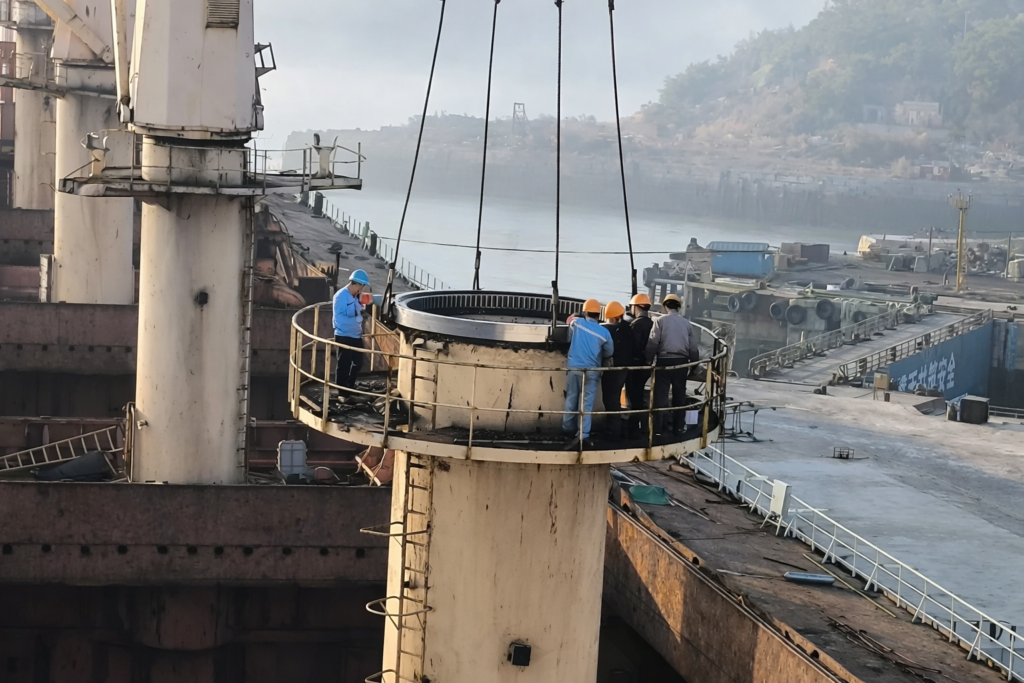
    I. Requirements for the Mounting Base

    (1) The mounting base for the slewing ring should undergo stress relief treatment after welding or casting processes. The mating mounting surface should be machined to remove burrs and debris. The mounting base must have sufficient rigidity and strength; generally, the flange connection surface thickness should not be less than 50mm.

    (2) When the radial load exceeds 10% of the axial load, radial positioning should be provided.

    (3) The flange mounting surface should be flat, dry, clean, and free of lubricants. For continuous surfaces that cannot be machined, injection molding methods should be used to ensure the accuracy of the mounting surface. If necessary, shim with copper sheets of varying thicknesses to level the surface.

    II. Pre-Installation Preparations

    (1) Before installation, when unpacking the bearing, check if the bearing rotates freely. Inspect the seals for integrity; replace them if damaged.

    (2) The淬火 soft zone of the slewing ring raceway (externally marked “S” or where the filling plug is located) should be positioned in a non-load-bearing area or an infrequently loaded area.

    (3) Before tightening the installation bolts, check the gear meshing to ensure the backlash meets the gear accuracy requirements. The reference value is 0.03 to 0.05 times the module. The highest point of the gear is usually marked with three green paint strokes.

    III. Connecting Bolts

    (1) High-strength bolts should be used for connecting the slewing ring. Select the appropriate strength grade based on the load conditions; the strength grade should not be lower than the specified Grade 8.8. Grade 10.9 high-strength bolts are typically used by default. Nuts should have a strength grade matching the bolts, and their mechanical properties must comply with regulations.

    (2) When installing bolts, tempered flat washers can be used. The use of spring lock washers is prohibited.

    (3) After radial positioning of the slewing ring, tighten the bolts crosswise using a torque wrench. Simultaneously, check the bearing’s free rotation status. When tightening the bolts, sufficient preload must be applied. The preload should be 60%-70% of the bolt material’s yield strength. The bolt preload should comply with the specified reference values.
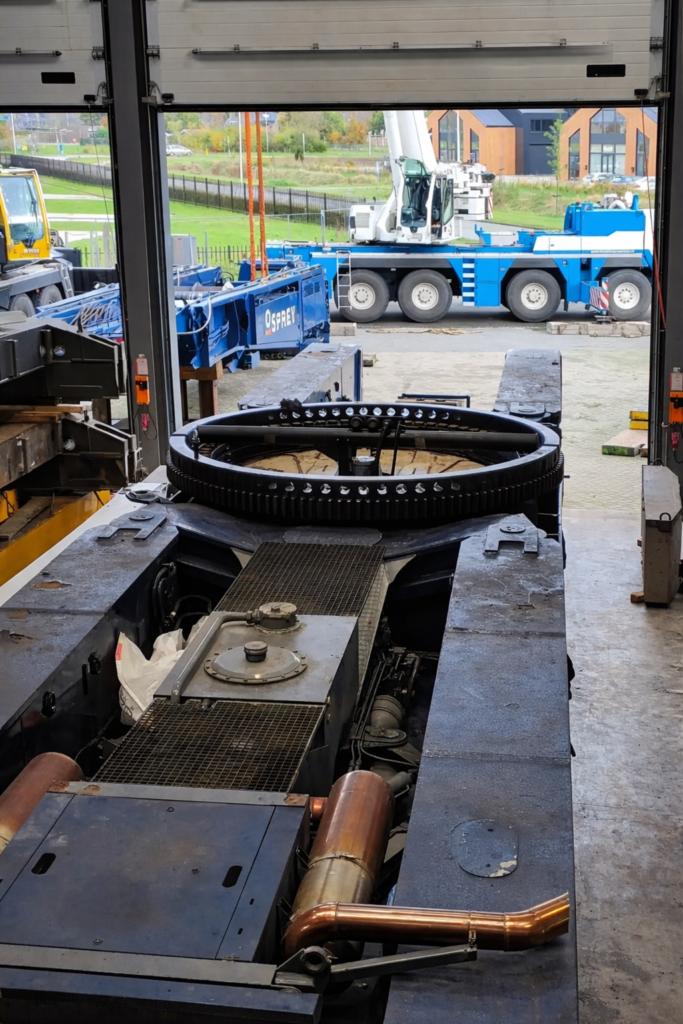
    IV. Lubrication and Maintenance

    (1) The slewing ring raceway is coated with a small amount of grease ex-factory. Before use, based on specific working conditions, refill with new grease.

    (2) Slewing rings should be lubricated regularly with grease at intervals of 50-100 hours. In special working environments (tropical, high humidity, dusty, large temperature variations) or during continuous operation, the lubrication interval should be shortened. Ample new grease must also be applied before and after prolonged machine shutdown. During each lubrication, fill the raceway with grease until it seeps out from the seals. Rotate the slewing ring slowly while lubricating to ensure even distribution of grease.

    (3) The gear teeth should be frequently cleaned of debris and coated with the appropriate grease.

    (4) Check the bolt preload after the first 100 hours of operation. Subsequently, check it every 500 hours of operation. Maintain sufficient preload at all times.

    (5) Pay attention to the operating condition of the slewing ring during use. If noise, impact, or a sudden increase in power consumption occurs, stop the machine immediately for inspection, troubleshoot, and disassemble for inspection if necessary.

    (6) Frequently inspect the condition of the seals. If the seal strip is damaged, replace it promptly. If it is detached, reposition it immediately.

    Hi, I am Maxwell, I am an engineer in the field of bearing applications. I majored in mechanical and electromechanical engineering during college. After graduation, I worked for the top three “SKF” bearing companies in the world for ten years. , during which I went to dozens of customers in different industries to help them solve problems in bearing applications; later I joined “vkuken” Bearing Manufacturing, and I will share bearing technical knowledge on this website from time to time. If you are a customer Please contact me to help you solve your problem; if you are also a technical expert in bearings, I am very willing to exchange technical knowledge about bearings with you.

    Exclusive solutions

    Steelworker at work near the tanks with hot metal
    Metallurgical equipment bearing solutions
    road construction
    Construction Machinery bearing solutions
    Vibrating Screen Equipment bearing solutions
    Transmission Equipment bearing solutions
    Coal mining in an open pit
    Mining Equipment bearing solutions
    Industrial robots
    industrial robot bearing solutions
    Latest Articles
    Non-standard customized ceramic bearings
    Chinese Ceramic Bearing Manufacturers: Analyze

    Chinese ceramic bearing manufacturers are globally recognized for their advanced technical strengths, including expertise in high-performance ceramic materials, precision engineering, and rigorous quality control. With

    Read More »
    Why more and more customers choose to cooperate with VKUKEN bearing for long time?

    When customers choose VKUKEN for the first time, it may be a trial. When customers choose VKUKEN for a long time, it must be that they have obtained satisfactory value.

    Latest Projects
    Mixer truck bearings
    Mixer truck bearings
    Vibrating screen bearings
    Vibrating screen bearings
    Metallurgical equipment bearings
    Metallurgical equipment bearings
    Rolling mill bearings
    Rolling mill bearings
    Vibrating screen bearings
    Vibrating screen bearings
    Food machinery bearings
    Food machinery bearings
    Chemical Machinery Bearings
    Chemical Machinery Bearings
    Textile machinery bearings
    Textile machinery bearings

    * vkuken takes your privacy seriously. All information is used for technical and commercial communication only and will not be disclosed to third parties. If you are interested in more bearing technology, you can click on this article for reference.

    Our team knows that every customer inquiry is very important; our professional engineers will reply to you within 24H.

    “Your contact information will be kept absolutely confidential and will not be disclosed.”

    Inquire now