
A Practical Sourcing and Supplier Evaluation Guide for Importers and Procurement Teams
When a buyer searches for a reliable slewing bearing manufacturer, the real challenge usually begins long before the first quotation arrives.
The difficulty is not simply finding companies that claim to manufacture slewing bearings. A quick online search can produce dozens or even hundreds of names. The real challenge is determining where those suppliers came from, whether they are genuine manufacturers, whether they can actually produce the bearing you need, and how to compare them objectively before placing an order.
As a slewing bearing manufacturer, I often see buyers begin the sourcing process in the wrong order. They first ask for prices, then compare quotations, and only later investigate who the suppliers actually are.
For large or customized slewing bearings, I recommend doing the opposite.
A more reliable sourcing process should follow three stages:
- Find manufacturers through trustworthy sourcing channels.
- Verify each supplier’s manufacturing, engineering, quality, and business capability.
- Compare qualified manufacturers using the same technical and commercial criteria before selecting the final supplier.
This approach reduces the risk of choosing a trader pretending to be a factory, selecting a manufacturer that is too small for the project, or awarding the order to the lowest bidder before understanding what is actually included in the quotation.
The purpose of this guide is to show buyers how I would carry out that process if I were sitting on the procurement side.
1. Start With the Right Question: Where Can I Find Real Slewing Bearing Manufacturers?
When buyers search for suppliers, the quality of the sourcing channel matters.
A supplier list built from random online advertisements is not the same as a supplier list built from industry-specific sources, trade fairs, technical references, and verified manufacturing information.
My first recommendation is therefore:
Do not treat every supplier-discovery channel as equally reliable.
Some channels are excellent for discovering manufacturers. Others are useful only as a starting point and require much deeper verification.
2. Use Search Engines, but Search Like a Technical Buyer
Google and other search engines are still one of the most useful places to start.
However, broad searches such as:
slewing bearing supplier
or:
slewing ring factory
often return a mixture of:
- Manufacturers
- Export companies
- Distributors
- Trading companies
- B2B directories
- Resellers
- SEO websites
Instead of searching only by product category, I recommend using more specific queries.
For example:
- large slewing bearing manufacturer
- three-row roller slewing bearing manufacturer
- crossed roller slewing bearing factory
- 42CrMo slewing bearing manufacturer
- custom slewing ring manufacturer
- slewing bearing manufacturer for crane
- slewing bearing manufacturer for mining equipment
- large diameter slewing ring factory
The more specific the search, the more likely you are to find companies whose capabilities match your application.
When reviewing a manufacturer’s website, I would look for evidence such as:
- Real production equipment
- Factory photographs
- Product drawings
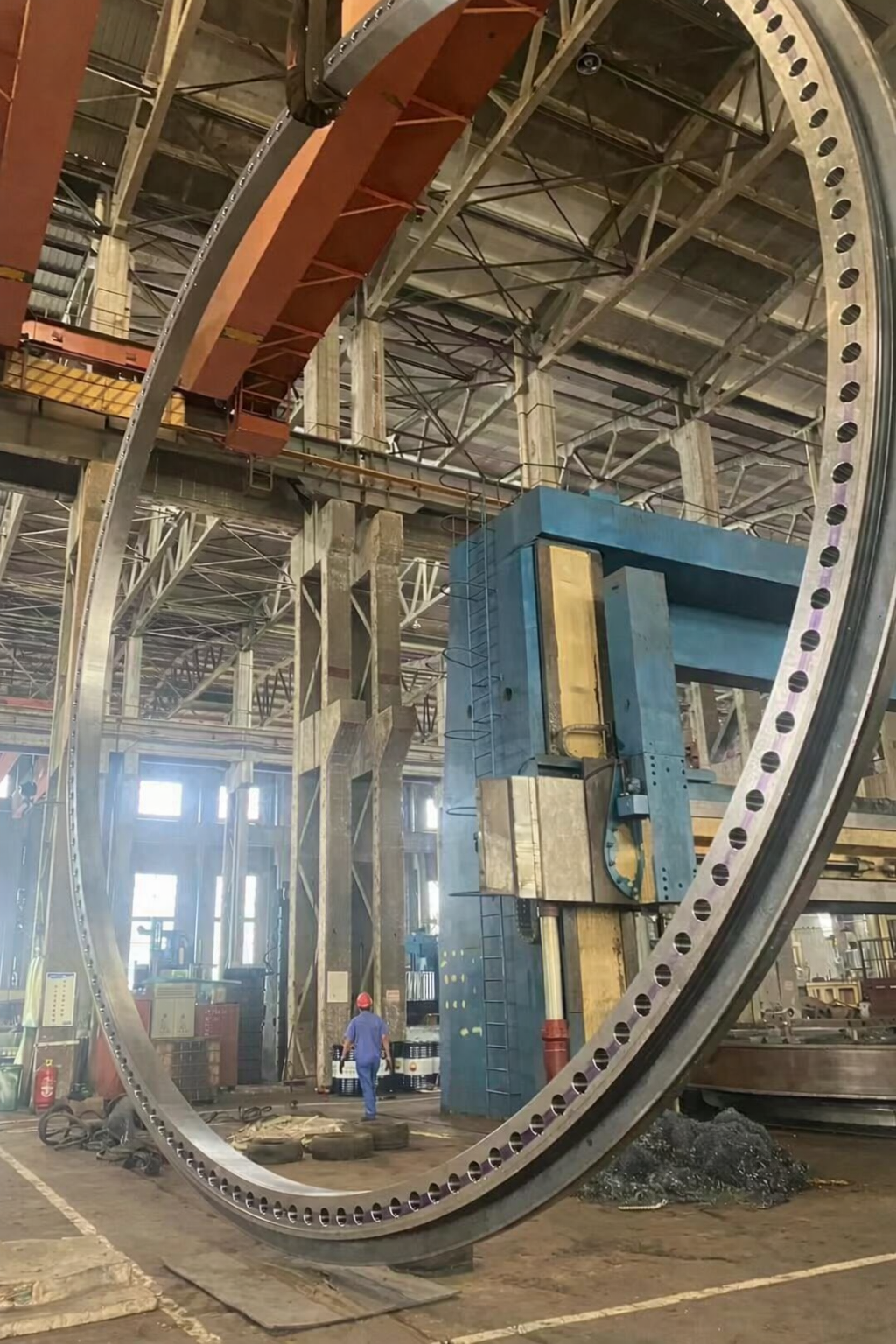
- Large-diameter machining capability
- Heat-treatment capability
- Gear manufacturing
- Inspection equipment
- Technical articles
- Application cases
- Actual product range
A website filled only with catalog pictures and sales claims tells me very little.
A good supplier website should help me understand what the factory actually manufactures and how it manufactures it.
3. Industry Trade Shows Are One of the Best Manufacturer Discovery Channels
For serious industrial sourcing, trade shows remain highly valuable.
Why?
Because a manufacturer that repeatedly exhibits at professional machinery, bearing, mining, crane, construction, or power-industry exhibitions is easier to investigate than an unknown company found only through an online advertisement.
Relevant trade shows can help buyers:
- Meet technical and sales teams directly
- Review samples
- Compare multiple manufacturers in one place
- Ask about equipment and production capacity
- Collect catalogs and company information
- Arrange factory visits
- Evaluate how deeply the supplier understands the product
Exhibitor lists are also useful before the exhibition.
I would often use them as a supplier-discovery database.
The important point is that a trade-show presence is not proof of quality, but it is a stronger starting signal than an anonymous web listing.
4. Industry Associations and Professional Directories Can Help Build a Shortlist
Industry associations, bearing organizations, machinery associations, chamber networks, and professional supplier directories can also help identify manufacturers.
These sources are useful because they may provide:
- Registered company names
- Manufacturing categories
- Membership information
- Industry specialization
- Geographic location
However, I would still verify every company independently.
Membership in an organization does not automatically prove that a manufacturer can produce your exact bearing.
I treat association listings as a supplier discovery source, not as final qualification.
5. B2B Platforms Are Useful, but Buyers Should Be Careful
B2B platforms can quickly provide a large number of suppliers.
That is their advantage.
Their disadvantage is exactly the same.
A buyer may receive 20 quotations within 24 hours, but those 20 suppliers may include:
- Real factories
- Small workshops
- Trading companies
- Export agents
- Brand distributors
- Companies subcontracting almost all production
B2B platforms are therefore useful for building an initial list, but I would never approve a slewing bearing supplier based only on:
- Supplier badges
- Platform years
- Product photos
- Response speed
- Star ratings
For large slewing bearings, the buyer must move beyond the platform and verify the actual manufacturer.
6. Customer Referrals and Industry Recommendations Are Highly Valuable
One of the strongest sourcing channels is still professional referral.
If another equipment manufacturer, OEM, distributor, maintenance company, or industry contact has successfully purchased similar slewing bearings from a factory, that information deserves serious attention.
A referral can provide information that websites rarely show:
- Whether delivery was on time
- Whether the bearing matched the drawing
- Whether quality was consistent
- Whether the supplier handled problems professionally
- Whether repeat orders were successful
However, the application must still be comparable.
A manufacturer that performs well on small excavator slewing bearings may not automatically be qualified for a 5-meter three-row roller bearing.
The question should always be:
Reliable for what type of slewing bearing?
7. Import and Export Records Can Provide Useful Supplier Clues
For international sourcing, trade and shipment data can also be useful.
This information may help buyers understand whether a company:
- Regularly exports bearings
- Ships to industrial markets
- Has repeat customers
- Handles international logistics
- Appears to have stable export activity
I would use this information as supporting evidence rather than absolute proof.
Export volume does not equal manufacturing capability.
A trading company may also export large volumes.
Still, shipment history can help determine whether a supplier has real international business experience.
8. LinkedIn and Professional Networks Can Help Verify the Organization Behind the Supplier
LinkedIn is useful for another reason.
It can help buyers understand whether the company appears to have:
- Engineers
- Quality personnel
- Production managers
- Export sales staff
- Technical management
- Long-term employees
This provides another layer of verification.
A company claiming to operate a large bearing factory but showing only two salespeople and no visible technical organization deserves additional investigation.
Again, LinkedIn should not be used as proof by itself.
It is one more data point.
9. Build a Long List First—Do Not Request Quotations From Everyone Immediately
Once I identify potential manufacturers, I would not send the RFQ to 30 companies at once.
That often produces a large amount of low-quality information.
Instead, I would build a long list and perform an initial screening.
For example:
Initial list: 15–20 suppliers
Then remove companies that clearly do not match:
- Required bearing size
- Required structure
- Required material
- Required application experience
- Required manufacturing capability
This may reduce the list to 6–8 suppliers.
Only then would I begin serious supplier qualification.
10. The Second Main Question: Is This Supplier Really Qualified to Manufacture My Bearing?
Once potential manufacturers have been found, the next stage is supplier qualification.
This is where buyers should move from marketing information to evidence.
I would divide the qualification process into several areas.
11. Verify the Legal Company and Manufacturing Identity
The first step is basic but essential.
I would confirm:
- Legal company name
- Registered address
- Factory address
- Business registration
- Exporting entity
- Manufacturing entity
This is particularly important when the company name on the quotation differs from the name shown on the factory gate, bank account, or certificates.
Different entities are not automatically suspicious.
Many manufacturing groups use separate export companies.
But the relationship should be clear.
I want to know:
Who signs the contract?
Who receives payment?
Who manufactures the bearing?
Who accepts responsibility for quality?
These questions should have clear answers.
12. Confirm That the Factory Can Manufacture Your Actual Bearing Size
A manufacturer may say:
“We produce slewing bearings from 300 mm to 6,000 mm.”
That sounds impressive.
But I would verify what that really means.
Can the factory perform every critical process at 6,000 mm?
For example:
- Turning
- Raceway machining
- Drilling
- Gear cutting
- Heat treatment
- Grinding
- Inspection
A supplier may have a large vertical lathe but lack a raceway grinder of the same capacity.
Another may manufacture large rings but outsource gear cutting.
This does not automatically disqualify the supplier.
But the buyer needs to know the actual manufacturing chain.
I would ask for an equipment list showing:
- Machine type
- Maximum workpiece diameter
- Accuracy capability
- Process performed
Then I would verify that information during a factory visit or live video audit.
13. Check Whether the Manufacturer Has Experience With Your Bearing Structure
Diameter alone is not enough.
I would verify experience with the actual bearing type:
- Four-point contact ball
- Double-row ball
- Crossed roller
- Three-row cylindrical roller
For example, if I need a three-row roller slewing bearing for a heavy crane, I would ask:
Have you manufactured three-row roller bearings of similar diameter and load before?
Then I would request:
- Similar production photos
- Drawings with confidential information removed
- Application examples
- Inspection reports
- Repeat-order evidence where possible
This is much more useful than a general statement such as:
“We have 20 years of experience.”
14. Review the Manufacturer’s Engineering Capability
For customized slewing bearings, engineering capability is just as important as machining capability.
A serious manufacturer should understand the customer’s application.
When I receive a new project, I normally expect technical information such as:
- Axial load
- Radial load
- Tilting moment
- Rotational speed
- Duty cycle
- Operating temperature
- Impact load
- Gear torque
- Installation structure
- Required life
If the buyer does not provide enough information, the manufacturer should ask.
That is an important qualification signal.
A supplier that receives a complex custom project and immediately quotes without asking technical questions may be pricing the drawing rather than evaluating the application.
For critical projects, I would ask the supplier to explain:
Why is this bearing design suitable for our operating conditions?
A competent engineering team should be able to explain the basis of the selection.
15. Evaluate Material Control
For large slewing bearings, I would investigate material control carefully.
Depending on design, materials may include:
- 50Mn
- 42CrMo
- Other alloy steels
The supplier should be able to explain:
- Material grade
- Steel or forging supplier
- Material certificate
- Heat number
- Incoming inspection
- Traceability
For critical forgings, ultrasonic testing may also be required.
The important issue is not simply whether the quotation says “42CrMo.”
I want to know whether that material can be traced throughout production.
16. Examine Raceway Heat-Treatment Capability
Raceway heat treatment is one of the most important manufacturing processes in a slewing bearing.
I would investigate:
- Heat-treatment method
- Raceway hardness
- Effective hardened depth
- Hardness distribution
- Soft-zone control
- Inspection records
For heavy-duty bearings, I would also check whether the manufacturer has experience controlling heat treatment on rings of similar diameter and cross-section.
The buyer should remember that poor heat treatment is difficult to identify from the finished appearance.
This is why process records matter.
17. Examine Gear Manufacturing Capability Separately
For geared slewing bearings, I would evaluate gear capability as its own category.
Important factors include:
- Internal or external gear
- Gear module
- Number of teeth
- Gear accuracy
- Gear runout
- Tooth hardness
- Gear heat treatment
A factory that is excellent at raceway machining may not necessarily have equally strong gear manufacturing capability.
If the gear is critical to the application, ask how it is produced and inspected.
18. Review Quality Control Throughout the Process
A statement such as:
“100% inspection before shipment”
is not enough for me.
I want to know what happens before final inspection.
A good quality system should cover the entire production process:
Raw material → turning → heat treatment → machining/grinding → gear processing → drilling → assembly → final inspection
At each critical stage, there should be measurable control points.
Depending on the bearing, these may include:
- Material inspection
- UT
- MPI
- Hardness
- Hardened depth
- Raceway dimensions
- Surface roughness
- Gear dimensions
- Gear runout
- Axial runout
- Radial runout
- Internal clearance
- Rotational torque
- Mounting-hole position
I prefer actual measurement records to generic quality statements.
19. Ask for Sample Inspection Documents Before Ordering
One of the most effective remote qualification methods is to request a sample inspection report from a similar bearing.
I would check whether the report shows:
- Drawing requirement
- Tolerance
- Actual measured value
- Inspection method
- Date
- Batch or product identification
A document containing only “PASS” tells me less than a report containing actual numerical values.
For custom projects, I would agree on the required inspection report before production starts.
20. Check Certifications, but Do Not Let Certificates Replace Factory Evaluation
Quality certifications are useful.
They show that the company has implemented certain management systems.
But they do not tell me whether the factory can manufacture my bearing correctly.
I would use certification as one part of the qualification process.
I would still verify:
- Equipment
- Engineering
- Process control
- Inspection
- Traceability
- Similar production experience
A certificate supports the decision.
It should not make the decision.
21. Evaluate Production Capacity and Delivery Reliability
Reliability also means delivering when promised.
I would ask:
- Normal lead time
- Current capacity
- Critical bottleneck processes
- Raw-material lead time
- Production planning method
- Ability to reserve capacity
- Experience with recurring orders
For annual supply projects, I would also discuss:
- Forecasts
- Framework orders
- Scheduled deliveries
- Material reservation
- Capacity reservation
A supplier that produces excellent bearings but repeatedly misses delivery can still create serious procurement problems.
22. Evaluate After-Sales and Problem-Solving Capability
I consider after-sales capability part of supplier qualification.
Before placing the order, I would ask:
- What happens if a bearing fails?
- Who performs the technical investigation?
- What information will you require?
- How is warranty responsibility determined?
- Can engineering support be provided?
- What is the claim-response process?
A mature manufacturer should understand that bearing failure analysis involves more than deciding whether the factory is responsible.
It may need to examine:
- Installation
- Load
- Lubrication
- Mounting flatness
- Gear backlash
- Bolt preload
- Contamination
- Operating history
A supplier that can investigate problems technically is more valuable than one that only handles sales.
23. The Third Main Question: How Do I Compare Several Qualified Manufacturers?
Once you have verified the suppliers, another problem appears.
You may now have five manufacturers that all look reasonably capable.
How do you choose the most reliable one?
This is where procurement discipline becomes important.
I would not choose based on intuition.
I would create a structured comparison.
24. First Normalize the RFQ
Every shortlisted manufacturer should receive the same technical package.
That package should include:
- Drawing
- Drawing revision
- Material
- Bearing structure
- Load conditions
- Gear requirements
- Heat treatment
- Precision
- Inspection
- Quantity
- Annual demand
- Delivery destination
- Required lead time
If suppliers quote different technical scopes, price comparison becomes meaningless.
For example:
Supplier A may quote 42CrMo with hardened gear.
Supplier B may quote 50Mn with a soft gear.
Supplier C may include UT and MPI.
Supplier D may include only standard inspection.
Their quotations cannot be compared directly.
Before comparing prices, normalize the technical content.
25. Use a Supplier Scorecard
For large or strategically important slewing bearings, I recommend using a weighted supplier scorecard.
A practical example is:
| Evaluation Area | Suggested Weight |
|---|---|
| Engineering capability | 20% |
| Manufacturing capability | 20% |
| Quality system & inspection | 20% |
| Similar product experience | 10% |
| Price competitiveness | 10% |
| Delivery capability | 8% |
| Communication & technical response | 5% |
| After-sales support | 4% |
| Business stability | 3% |
The weight can change depending on the application.
For a crane, offshore system, or heavy mining machine, engineering and quality may deserve more weight.
For a relatively standard low-risk bearing, price and delivery may carry more weight.
The key principle is:
Price should be one part of supplier selection, not the entire supplier selection system.
26. Compare Evidence, Not Supplier Claims
Most suppliers will say:
- We have high quality.
- We have advanced equipment.
- We have many years of experience.
- We offer competitive prices.
These statements do not help much.
I would convert every claim into evidence.
Instead of:
“We have advanced equipment.”
ask:
Which machine will produce our bearing?
Instead of:
“We have strict quality control.”
ask:
Show us a sample inspection record.
Instead of:
“We use high-quality steel.”
ask:
Which material grade and steel source?
Instead of:
“We have made many large bearings.”
ask:
Show similar bearings of this structure and diameter.
Reliable suppliers are usually easier to verify because they can support their claims with technical information.
27. Compare the Manufacturers’ Technical Responses
The quality of the quotation is only one signal.
I would also compare how the suppliers respond to the project.
For example:
Manufacturer A sends a price within two hours but asks no technical questions.
Manufacturer B takes two days, asks about maximum moment load, mounting rigidity, gear torque, and working temperature, and then proposes a design revision.
Manufacturer B may initially appear slower.
But from an engineering standpoint, its response may be far more valuable.
For customized slewing bearings, I would consider the quality of technical communication an important supplier-selection factor.
28. Compare the Price Only After Everything Else Is Aligned
After technical normalization, price becomes meaningful.
Then I would ask:
Why is Supplier A cheaper?
Possible legitimate reasons include:
- Better equipment utilization
- Larger production volume
- Existing tooling
- Stronger raw-material purchasing
- More in-house production
- Lower sales-channel cost
But a lower price may also come from:
- Cheaper material
- Reduced heat treatment
- Lower precision
- Less inspection
- Lower design margin
The buyer needs to understand which one applies.
Similarly, an expensive supplier should also explain its premium.
A high price is not automatically evidence of better quality.
29. Visit or Audit the Final Two or Three Manufacturers
Once the list has been reduced, I would audit the strongest candidates.
Ideally, visit the factory.
If this is not practical, arrange:
- Live video factory audit
- Third-party audit
- Independent inspection
During the audit, I would follow the production route:
Raw material → machining → heat treatment → gear → grinding → drilling → assembly → inspection
Then compare what I see with what the supplier claimed earlier.
Consistency is important.
30. Use a Trial Order or Controlled First Order Where Practical
For a new supplier, I would reduce risk before expanding cooperation.
Depending on the bearing, this could involve:
- Prototype
- Small batch
- First-article inspection
- Third-party inspection
- Customer witness inspection
For very large one-off bearings where a sample is impossible, I would use stronger process control.
For example:
- Drawing approval
- Material certificate approval
- UT before machining
- Heat-treatment report
- Gear inspection
- Final dimensional report
- Pre-shipment inspection
The higher the consequence of failure, the more supplier verification should occur before shipment.
31. A Practical Three-Stage Supplier Selection Process
If I were sourcing a new slewing bearing supplier today, I would follow this process.
Stage 1 — Find Manufacturers
Use:
- Technical search-engine searches
- Industry trade shows
- Industry associations
- Professional directories
- Customer referrals
- B2B platforms
- Import/export information
- Professional networks
Build an initial list of approximately 15–20 companies.
Stage 2 — Qualify Manufacturers
Reduce the list based on:
- Manufacturing identity
- Bearing size capability
- Bearing-type experience
- Engineering capability
- Equipment
- Material control
- Heat treatment
- Gear production
- Quality system
- Inspection
- Delivery capacity
- After-sales capability
Reduce the list to approximately 3–5 serious candidates.
Stage 3 — Compare and Select
Send the same RFQ to all finalists.
Then compare:
- Technical proposal
- Manufacturing plan
- Quality requirements
- Inspection
- Delivery
- Warranty
- Price
- Communication
Audit the strongest suppliers.
Finally select the manufacturer that provides the best overall balance of:
Engineering + manufacturing + quality + delivery + service + price
That is a far more reliable sourcing method than simply collecting ten quotations and choosing the cheapest.
32. Red Flags I Would Take Seriously
During supplier selection, several warning signs deserve additional investigation:
- The supplier will not clearly identify the factory.
- The company claims an extremely wide product range but shows little manufacturing evidence.
- Technical questions are answered only by salespeople.
- The supplier quotes complex custom bearings without asking about loads.
- Equipment capability does not match the claimed maximum bearing size.
- Inspection reports contain no actual values.
- Material traceability is unclear.
- Heat-treatment information is vague.
- The supplier refuses audits without reasonable explanation.
- Quotation details change repeatedly.
- Drawing revisions are poorly controlled.
- The supplier cannot explain why its price is much lower than competitors.
One warning sign alone may not mean the supplier is unreliable.
Several together should significantly increase the level of due diligence.
Frequently Asked Questions
Where is the best place to find slewing bearing manufacturers?
There is no single best source. I recommend combining search engines, industrial exhibitions, industry associations, professional referrals, B2B platforms, trade data, and professional networks. A supplier appearing in multiple credible channels is easier to investigate.
How can I tell whether a company is really a manufacturer?
Verify the legal entity, factory address, equipment, production process, engineering team, inspection capability, and actual production records. A live factory audit is particularly useful.
Should I buy directly from a manufacturer?
For large, customized, technically complex, or recurring slewing bearing orders, direct manufacturer cooperation can provide significant advantages. For small urgent replacement orders, a distributor may offer better total value.
Is the largest manufacturer always the safest choice?
No. The best manufacturer is the one whose equipment, engineering capability, product experience, and quality system match your specific bearing.
How many suppliers should I compare?
For serious sourcing, I would usually start with a broader list, narrow it to several qualified manufacturers, and perform detailed comparison on approximately three to five strong candidates.
Should price be included in supplier qualification?
Yes, but only after technical specifications have been normalized. Price should be evaluated together with engineering, manufacturing, quality, delivery, and service.
Conclusion
When buyers ask me:
How do I choose a reliable slewing bearing manufacturer?
I believe the answer has three parts.
First, find suppliers through the right channels.
Do not depend on a single B2B platform or a random search result. Use multiple industry sources and build a broad but relevant supplier list.
Second, verify the manufacturers behind the marketing.
Check the factory, equipment, engineering capability, material control, heat treatment, gear production, inspection, capacity, and after-sales support.
Third, compare qualified manufacturers using the same criteria.
Send the same technical requirement to each supplier, normalize the quotation, score the suppliers objectively, audit the strongest candidates, and only then compare price.
The most reliable slewing bearing manufacturer is not necessarily:
- The largest company
- The cheapest company
- The most famous company
- The company with the best website
It is the manufacturer that can provide the strongest evidence that it can design or correctly interpret your requirement, manufacture the bearing consistently, verify the result, deliver it reliably, and support you after installation.
That is the supplier I would choose if I were the buyer.