Skip to content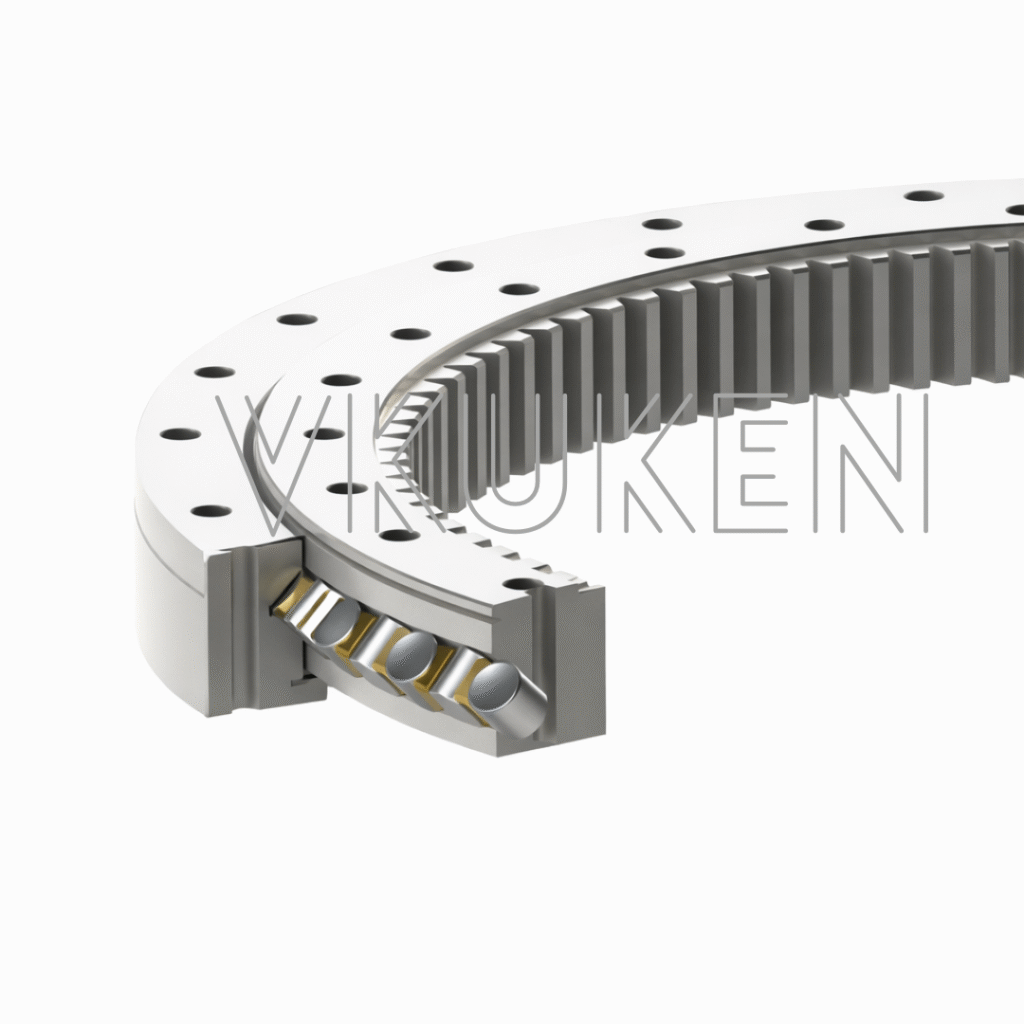
Our Cross Cylindrical Roller Slewing Bearing is widely used in machine tool rotary tables, robots and robotic arms, construction and hoisting machinery, and other fields due to its excellent rigidity and stability, high rotational accuracy, and smooth low-speed operation.
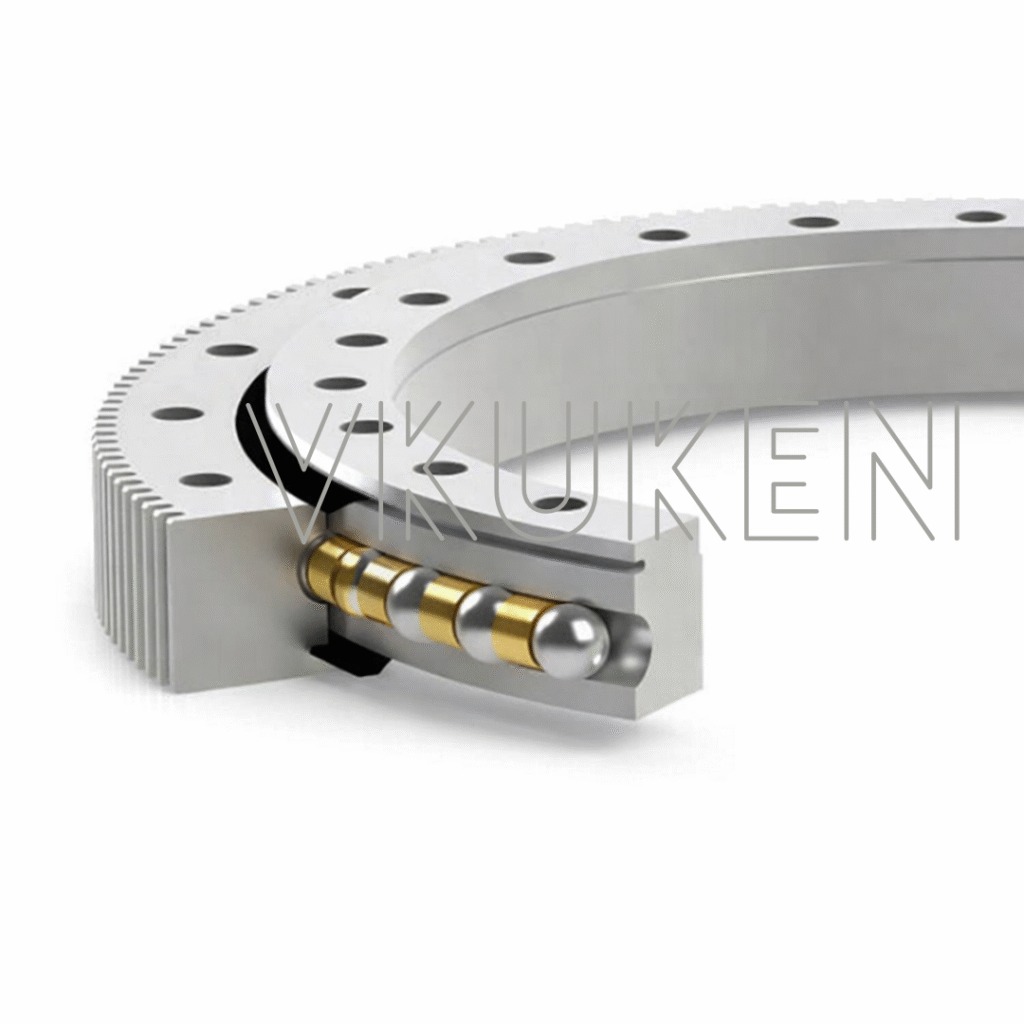
Our Four Point Contact Ball Slewing Bearing is widely used in mobile crane equipment, turntable systems, packaging automation equipment and other fields due to its advantages such as compact structure, light weight, smooth rotation and strong comprehensive load-bearing capacity.
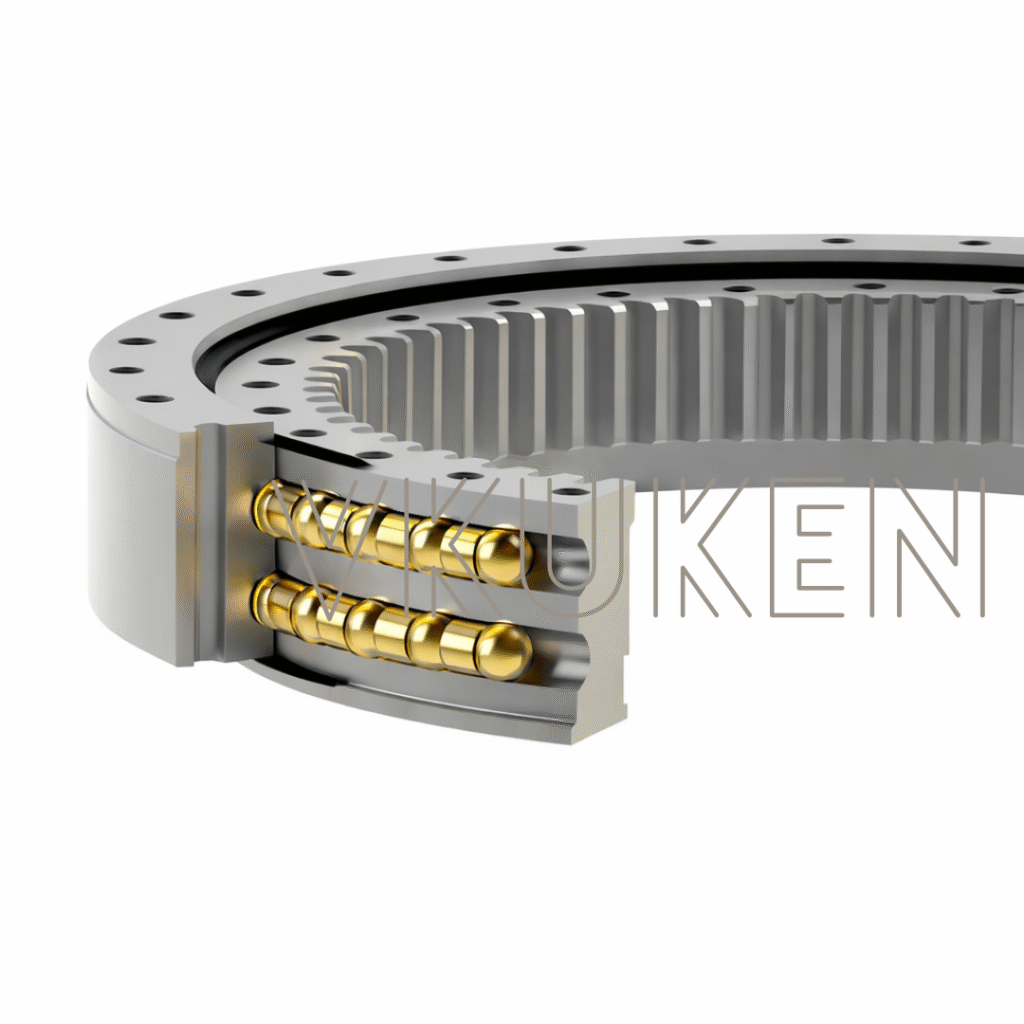
Our double-row ball slewing bearings are widely used in construction machinery, concrete pumps, aerial work platforms, and renewable energy equipment due to their balanced load-bearing capacity and smooth rotation performance.
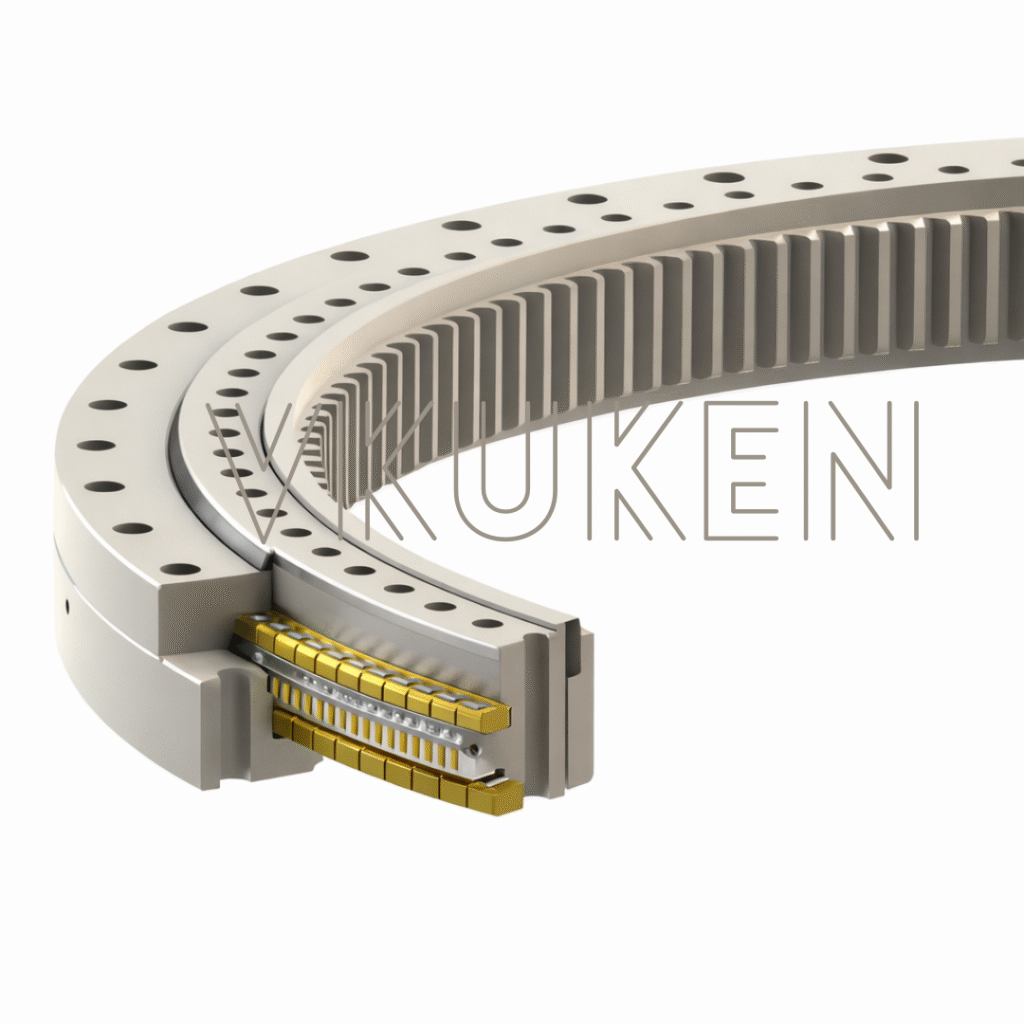
Our three-row cylindrical roller slewing bearings are widely used in crawler cranes, mining and bulk material handling equipment, metallurgical and industrial equipment, and other fields due to their excellent load-bearing capacity and structural stability.
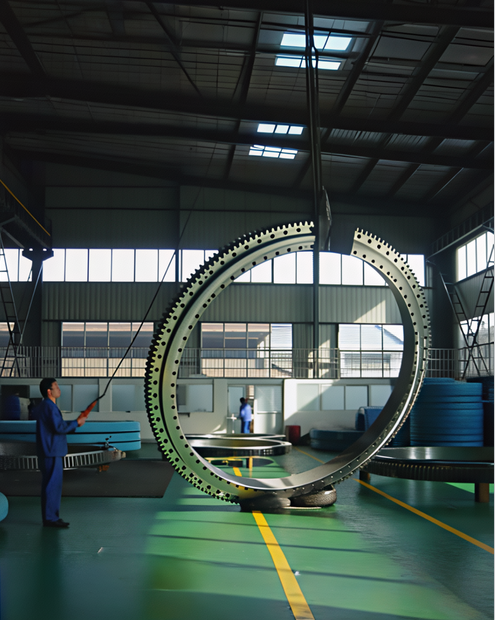
Slew ring bearing, also known as a slewing ring or turntable bearing, is a rotational rolling-element bearing that typically supports a heavy but slow-turning or slow-oscillating load, often a horizontal platform such as a conventional crane, a swing yarder, or the wind-facing platform of a horizontal-axis windmill. It consists of an inner ring and an outer ring, one of which usually incorporates a gear. Together with attachment holes in both rings, they enable an optimized power transmission with a simple and quick connection between adjacent machine components.
When selecting slew ring bearings, you need to consider the following:
1. Determine load conditions: Accurately calculate all working loads applied to the bearing (bearing load, radial load, overturning moment).
2. Select the appropriate bearing type: Choose the appropriate bearing structure based on the load rating and stiffness requirements.
3. Determine installation and structural limitations: You need to assess mechanical and space constraints.
4. Consider operating conditions: Analyze the actual operating environment (temperature range, operating cycle, exposure).
5. Determine accuracy and performance: Required rotational accuracy and runout limits, permissible frictional torque, noise and vibration limits.
6. Select gear and drive configuration: Select internal or external meshing based on the drive layout, and verify gear module, tooth hardness, and backlash.
7. Consider service life and maintenance: Consider expected service life and maintenance requirements, including lubrication and inspection cycles.
8. Compliance and safety requirements: Confirm relevant standards and certifications (ISO9001, DIN, GB/T307、JB/2300、CB/T3669、JB/T10471、JB/T10705、or industry-specific specifications), project-specific safety factors, and inspection requirements.
Slew ring bearing selection must be based on a system-level analysis, not only catalog data. Providing accurate load calculations, working conditions, and installation details to the manufacturer allows for optimized bearing selection, higher safety margins, and longer service life.
Globally, there are few factories capable of manufacturing slew bearings due to the significant investment required, including expensive machining equipment and overhead cranes. The ability to organize transportation is also crucial.
We are a state-owned and majority-controlled slew bearing manufacturer with world-class production and lifting equipment, and a highly skilled engineering team. We can provide you with comprehensive technical services including on-site surveying, design, bearing selection, and installation support for slew bearings.
If you want to know more about “More Slewing Bearings”, you can also search for relevant information in the blog or download page of this website, or you can send us a message directly to explain your needs. Our professional engineers will reply you immediately after receiving your message.
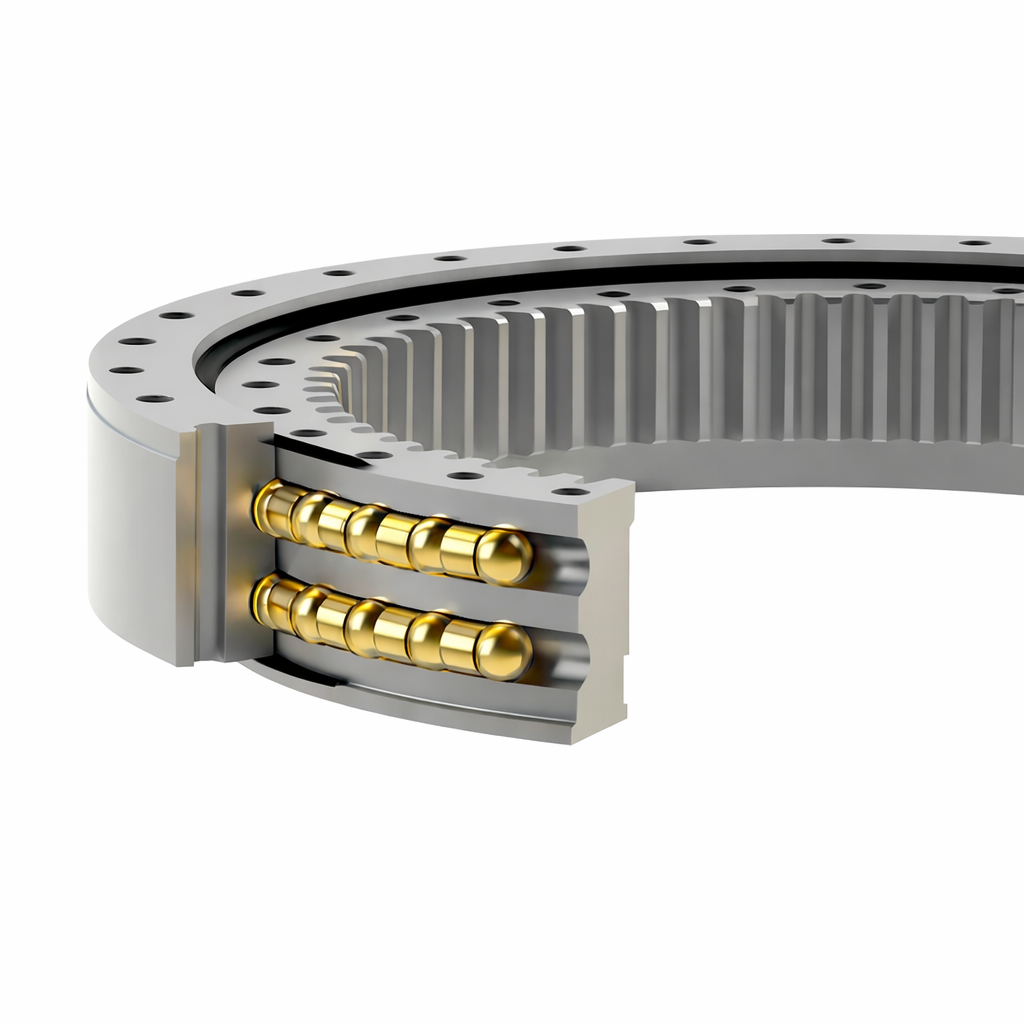
Based on proportional calculations, the steel balls in slewing bearings are generally taken as height H × 0.375 or 0.45. If the bearing ring height is 70mm, then 70 × 0.375 = 26.25 or 70 × 0.45 = 31.5mm. In this case, a diameter of ø30 is suitable. For double-row ball bearings, the general formula is height H ÷ 3.8. For example, if the ring height is 120mm, then 120 ÷ 3.8 = 31.5789474mm. Therefore, ø30 steel balls are suitable.
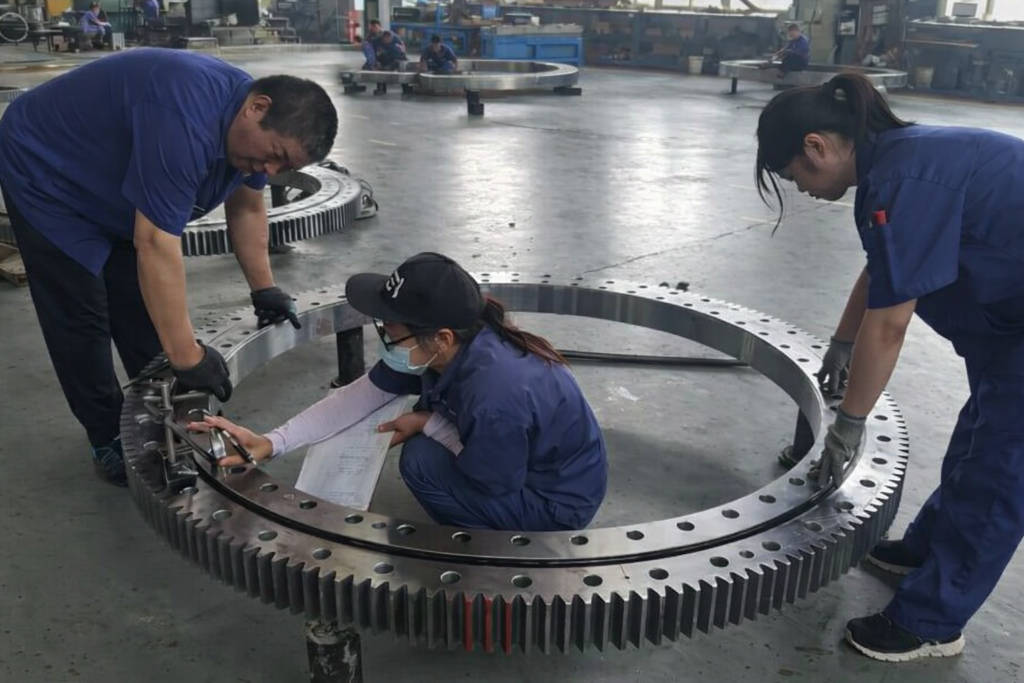
Using bearing clearance as the benchmark for wear evaluation, if the drawing specifies a clearance range of 0.15–0.35 mm, then 0.35 mm represents the maximum allowable clearance under design conditions.
When the measured clearance exceeds twice the maximum value (approximately 0.7 mm), the bearing requires maintenance and repair.
When the clearance exceeds three times the maximum value (approximately 1.0 mm), preparation for new bearing replacement is required.
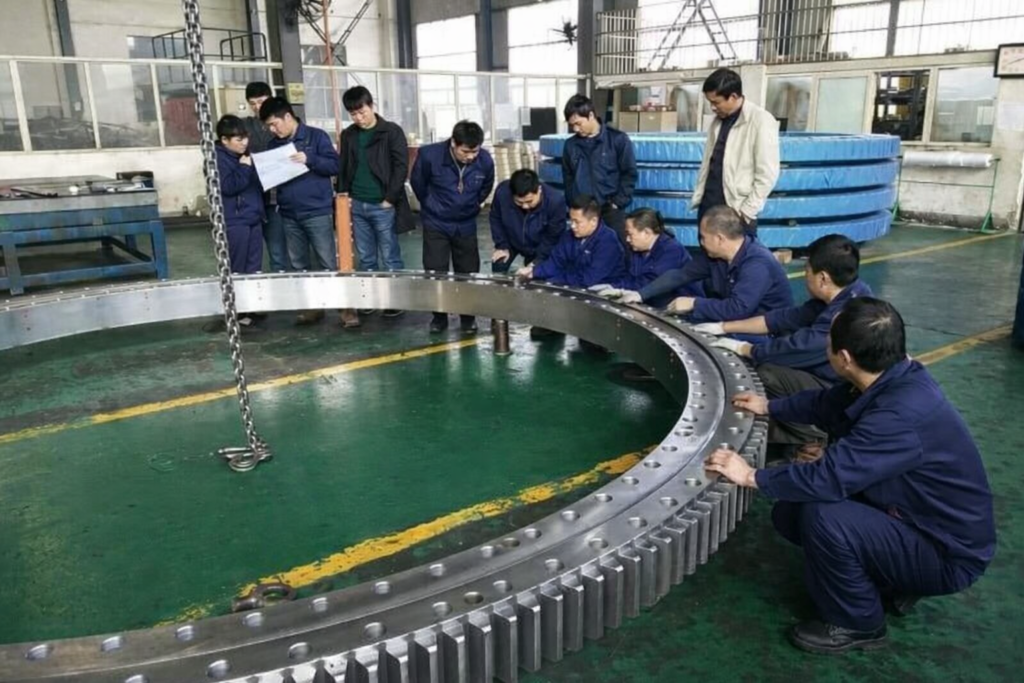
Confirm all mounting hole data, including hole chord length, which is calculated as follows:
Chord length = Pitch circle diameter × sin (180° ÷ number of holes)
Example: Crane slewing bearing model 2890
Outer ring pitch circle diameter: 3005 mm, 60 holes Ø39
Inner ring pitch circle diameter: 2775 mm, 60 holes M36
Outer ring hole chord length:
3005 × sin (180° ÷ 60) = 157.27 mm
Inner ring hole chord length:
2775 × sin (180° ÷ 60) = 145.23 mm
During actual measurement, attention must be paid to adding or subtracting one hole diameter to ensure accuracy.
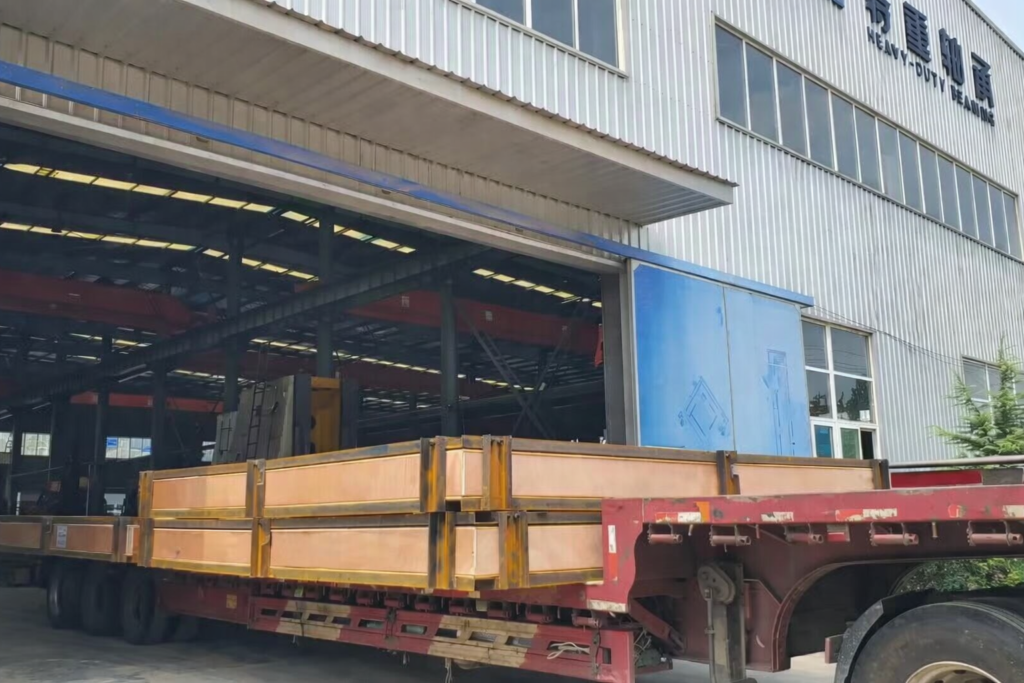
We solve the transportation challenges of ultra-large slewing bearings through customized packaging, container optimization, heavy-lift vessels, controlled road transport, and destination-oriented design. From standard containers to heavy-lift ships, our solutions ensure safe global delivery of bearings up to 14 meters in diameter.
The mounting base for slewing bearings should undergo stress relief treatment after welding or casting, and the mating mounting surfaces should be machined to remove burrs and debris. In addition to sufficient rigidity and strength, the mounting base should generally have a flange connection surface width of at least 50mm. Radial positioning should be provided when the radial load exceeds 10% of the axial load.
 Optimized by Seraphinite Accelerator